A patio umbrella is the least glamorous shade structure you will ever buy, and almost certainly the one you will use the most. It goes up in May, comes down in October, moves wherever the sun happens to be, and costs a fraction of a permanent build. In Canada, where the outdoor living season runs roughly twenty weeks from the May long weekend to Thanksgiving, that flexibility is worth a great deal.
The difficulty is that "patio umbrella" covers three genuinely different products: a lightweight beach umbrella you carry in one hand, a crank-and-tilt market umbrella anchored to a weighted base, and a large rotating deluxe model that shades an entire dining set from one side. Choosing the wrong category is the usual reason people conclude that umbrellas simply do not work in Canadian wind. This guide covers the three types we stock, how to size a canopy to your table, and the part most buyers skip entirely — picking a base heavy enough, and wide enough at the pole, to keep the whole thing standing.
The Three Kinds of Patio Umbrella
Almost every umbrella sold for outdoor use in Canada falls into one of three families. They differ in how they are supported, not just in size, and that support method decides where you can realistically use them.
Portable beach umbrellas: 6 to 7 feet
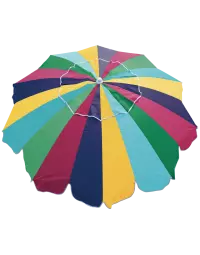
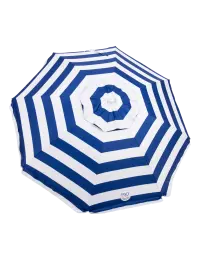
These are the tilting, steel-poled umbrellas with an integrated sand anchor — the screw-in spike at the base of the pole that twists into sand or soft ground. RIO builds most of what we carry here, in 6-foot and 7-foot canopies, including a 20-panel version with a fold-flat carry bag.
The specifications matter more than the price. The poles and ribs are powder-coated steel, which is what keeps them from rusting through after two seasons at a lake. The fabric is heavy-duty polyester with a silver sun-blocking undercoating and a UPF 50+ rating, and the range is recommended by the Skin Cancer Foundation — a meaningful distinction if the umbrella is mainly there to keep children out of midday sun. Every model has a wind vent, the mesh-covered gap near the top that lets a gust pass through instead of lifting the canopy, plus a tilt joint so you can angle the shade as the sun drops.
What they are not is a permanent patio umbrella. The sand anchor needs sand or soft earth; it will not hold in a deck, on pavers, or on a concrete pad. Buy one of these for the beach, the campsite, or a soccer sideline — not for the dining table.
Market umbrellas: 8.5 feet, crank and tilt
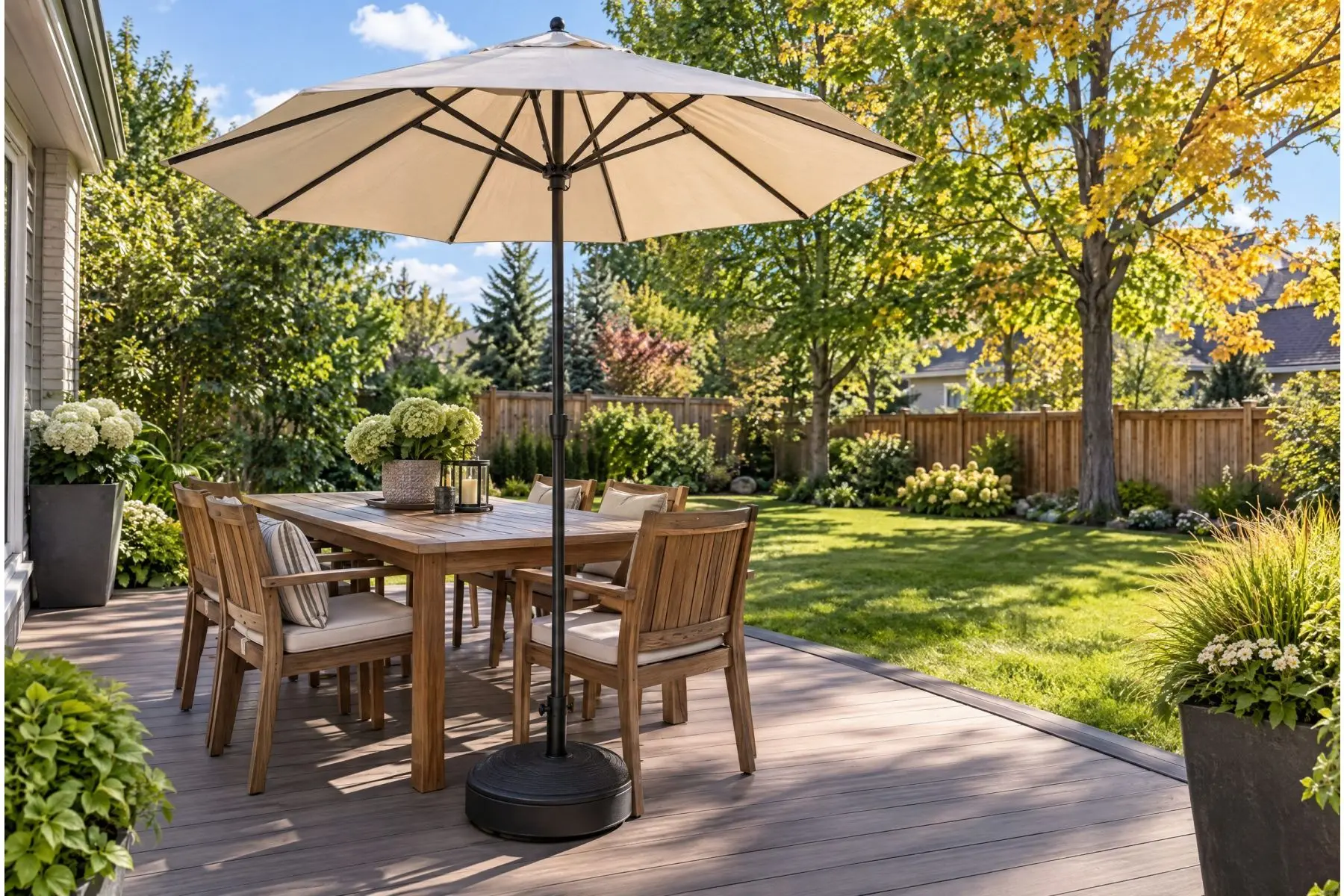
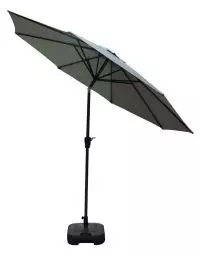
This is the classic backyard umbrella and the one most Canadian households actually need. Our 8.5-foot octagonal model from Corriveau has an aluminum frame, waterproof polyester canopy, an eight-rib support structure, and a crank that opens the canopy without you wrestling the fabric. Multiple tilt positions let you chase the afternoon sun westward across the deck.
Two numbers on the spec sheet do the real work. The pole is 40 mm in diameter, which determines which bases will physically accept it. And the manufacturer recommends a minimum 53-pound base, sold separately. That second figure is not a suggestion — see the section on bases below.
Large-format rotating umbrellas: 10 feet
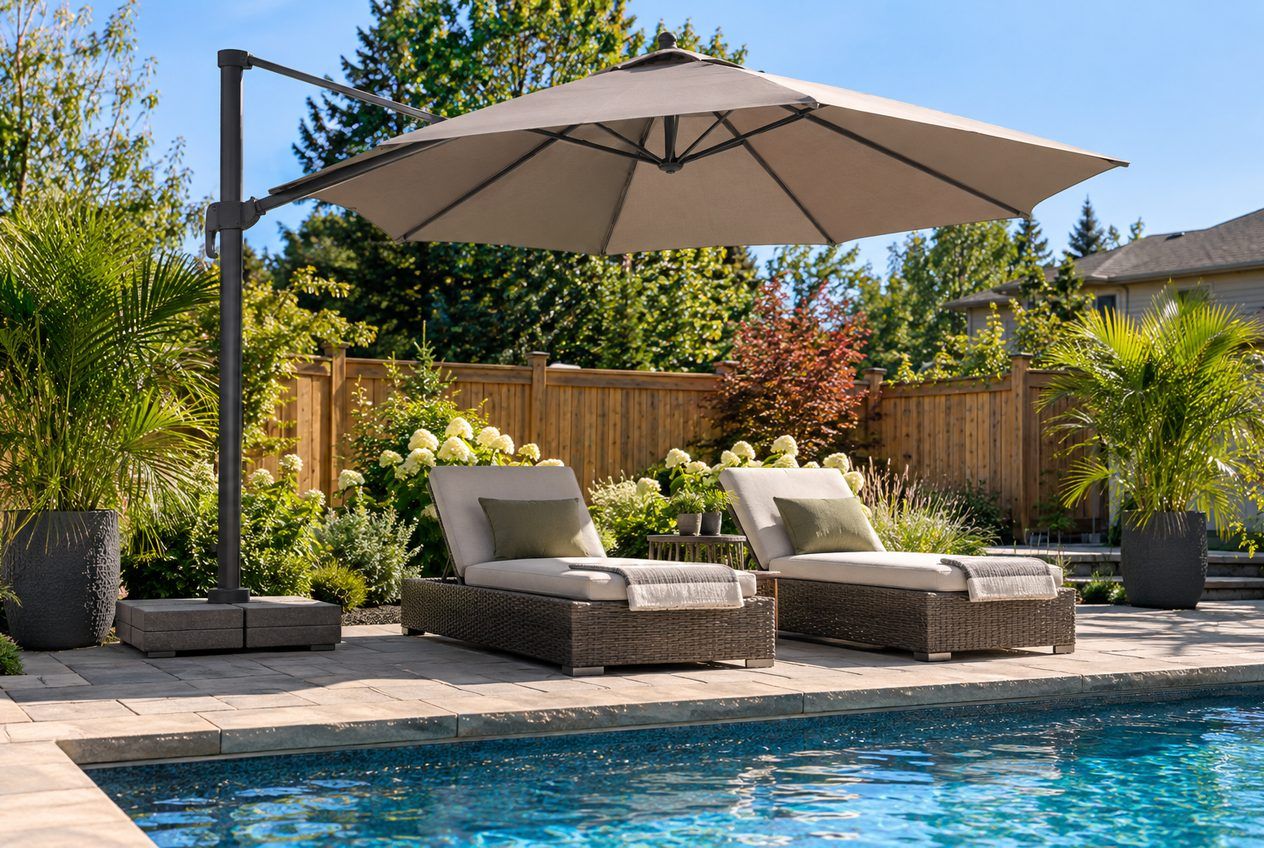
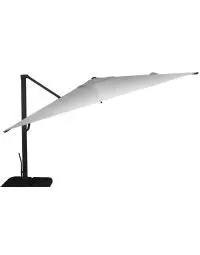
At the top of the range sits the Oasis Deluxe 10-foot umbrella, available in cream, taupe and charcoal. It is a square 10-foot canopy on a rustproof aluminum frame with 250 g polyester fabric chosen for UV and fade resistance, and it moves in ways a centre-pole umbrella cannot: a handle sets six separate inclinations, a crank rotates the canopy left to right to place the shade exactly where you want it, and a lever allows full 360-degree rotation of the whole unit. A protective cover is included, which is unusual at any price and genuinely extends the canopy's life.
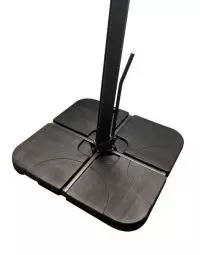
This is the umbrella for a large dining set, a sectional, or a hot tub — anywhere a centre pole would be in the way. It demands a serious base, and the matching Oasis base is built for it: a plastic-and-steel cross base on wheels, filled with roughly 100 litres of water or sand, measuring 33 by 33 inches and 6.7 inches high, accepting a pole up to 160 mm in diameter.
Quick Comparison
| Type | Canopy size | How it stands up | Best for | Approx. price |
|---|---|---|---|---|
| Beach umbrella (RIO) | 6–7 ft | Integrated sand anchor | Beach, camping, sports sidelines | $37–$80 |
| Market umbrella (Corriveau) | 8.5 ft octagonal | Weighted base, 53 lb minimum | Patio dining tables, decks | ~$109 + base |
| Oasis Deluxe rotating | 10 ft square | 100 L filled wheeled base | Large seating areas, hot tubs | ~$899 + base |
Prices are approximate and current at the time of writing. Bases are sold separately for the market and deluxe models, and should be budgeted from the start rather than added later.
Sizing: Match the Canopy to the Table, Not the Deck
The standard rule is that the canopy should extend roughly two feet past the edge of your table on every side. That overhang is what keeps people shaded when the sun is low, which in Canada is most of the time — in September, Toronto and Montreal sit at a sun angle where shade falls sideways, not straight down.
Working backwards from that rule: a four-seat bistro table of about 30 to 36 inches is well served by a 6- to 7-foot canopy. A standard six-seat rectangular table around 60 inches wants the 8.5-foot octagonal. Anything larger — an eight-seat table, a sectional, or a lounge grouping — is where the 10-foot square canopy earns its price, especially since a side-mounted rotating model leaves the middle of the table free.
One more consideration specific to decks: check the pole clearance through your table. Most outdoor tables have a 1.5- to 2-inch umbrella hole, which accommodates a 40 mm pole comfortably. Rotating models like the Oasis do not pass through a table at all — they stand beside it, so you need roughly three feet of clear floor for the base.
The Base Is Not an Accessory
More umbrellas are destroyed by underweighted bases than by any other cause. A canopy is a sail; an 8.5-foot octagonal umbrella presents something close to 60 square feet of surface to the wind. Manufacturers publish minimum base weights because they have tested what happens below them.
Products in this guide
Two specifications have to line up, and buyers routinely check only the first:
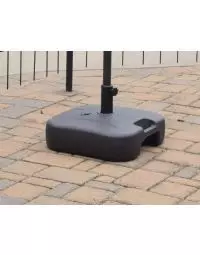
- Weight. The 8.5-foot Corriveau umbrella calls for a minimum of 53 pounds. The matching base is a plastic shell you fill yourself — with water for seasonal use, or with concrete if the umbrella lives in one permanent spot — reaching at least that 53-pound figure once filled. Water-filled bases must be drained before the first hard frost or the shell will split.
- Pole diameter. This is the one that trips people up. The Oasis base accepts a pole up to 160 mm; the 8.5-foot market umbrella has a 40 mm pole. A base sized for a large deluxe umbrella will not grip a slim market pole without an adapter, and a base built for a 40 mm pole cannot physically accept a heavier mast. Always check the two numbers against each other before ordering.
If your umbrella passes through a patio table, the table carries some of the lateral load and you can sometimes run slightly lighter. If it stands free — on a deck, beside a lounge set, or anywhere on the Prairies — go heavier than the minimum, not lighter.
Wind, Sun and Rain: the Canadian Reality
Canadian patios face a specific combination: intense summer UV at surprisingly high latitudes, sudden convective thunderstorms through July and August, and shoulder-season winds that arrive without much warning. Three features address this directly.
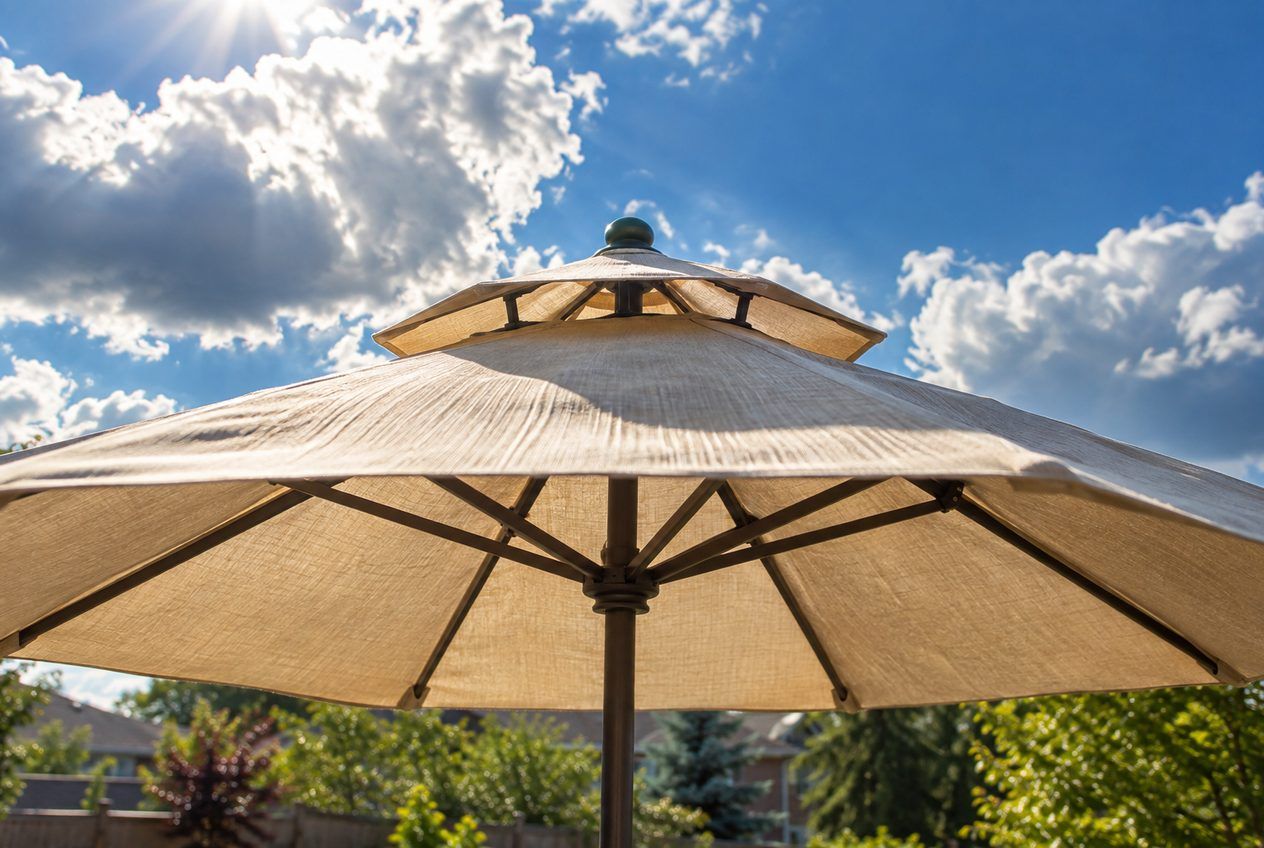
Wind vents are the single most useful feature on a value umbrella. The vent lets pressure escape through the top rather than lifting the canopy, and every RIO beach umbrella in our range includes one. Tilt mechanisms matter more here than in southern climates because our sun sits lower; a fixed canopy at 6 p.m. in Halifax shades the table and nobody sitting at it. UPF 50+ fabric with a sun-blocking undercoating is the difference between shade that feels cooler and shade that actually blocks UV.
The rule no feature replaces: close the umbrella when you leave the yard. No wind vent, tilt joint or 100-litre base is designed to survive an unattended thunderstorm with the canopy open. If you want shade that stays up through weather, you are looking at a different product — a pergola, a gazebo, or one of the fixed canopies — not an umbrella.
End-of-Season Care
An umbrella that gets put away properly lasts five or six seasons; one left out lasts two. In most of the country, late October is the deadline.
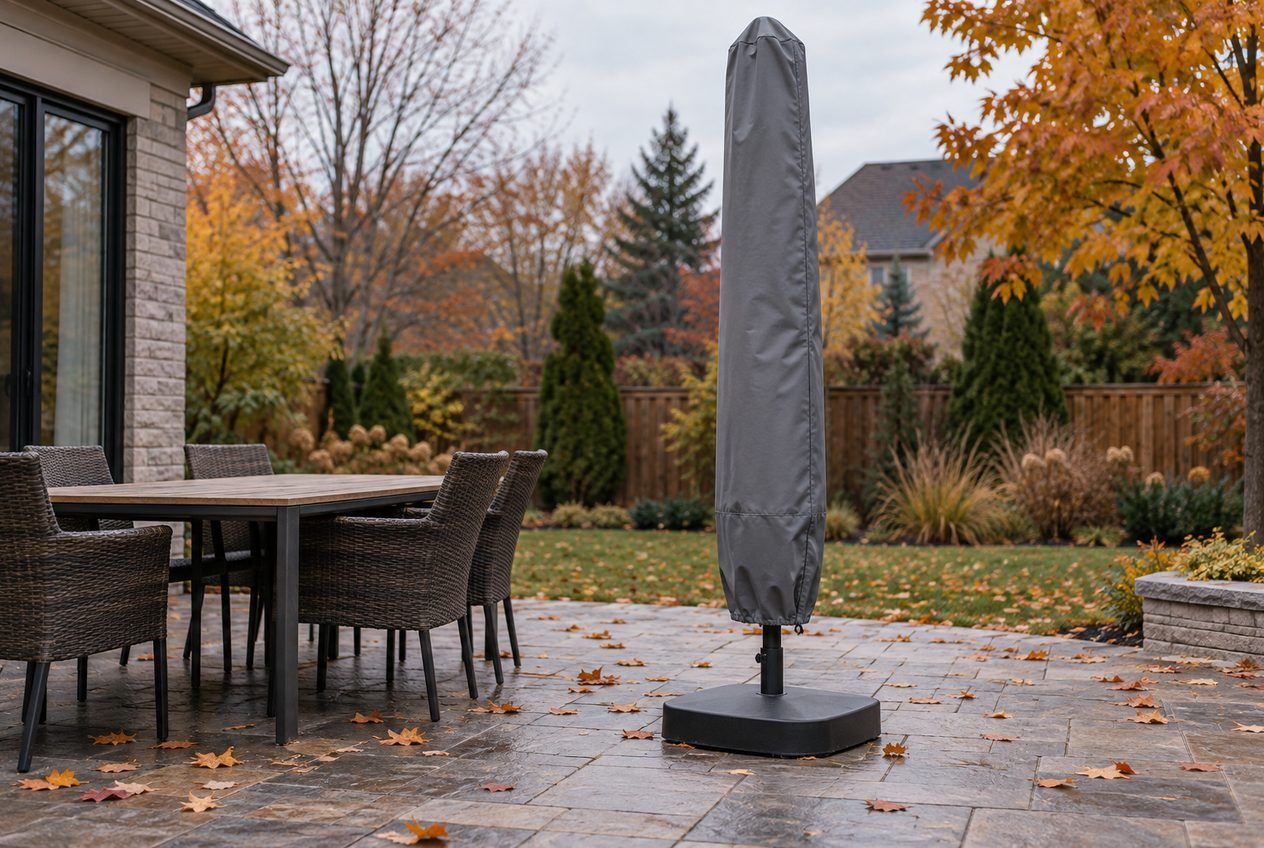
Dry the canopy completely before closing it — folding a damp polyester canopy and leaving it closed for five months is the fastest route to mildew staining that never fully comes out. Clean the fabric with mild soap and cool water, never a pressure washer, which drives water through the weave and strips the sun-blocking coating. Drain water-filled bases fully. Store the umbrella closed and upright, or lying flat off the ground, in a shed or garage; if it must stay outside, use a fitted cover. The Oasis Deluxe includes one, and dedicated winter covers are available for the rest. Put the outdoor cushions away in a deck box on the same afternoon — it is one job, not two.
Frequently Asked Questions
What size patio umbrella do I need for a six-seat table?
An 8.5-foot octagonal canopy is the right match for a standard 60-inch six-seat table. The guiding rule is roughly two feet of canopy overhang past the table edge on all sides, which keeps people shaded when the sun is low — the usual situation in Canada outside of midday in July.
How heavy does a patio umbrella base need to be?
Follow the manufacturer's minimum and exceed it if the umbrella stands free. Our 8.5-foot octagonal model specifies a minimum 53-pound base, and the matching fillable base reaches that weight with water or concrete. Large rotating umbrellas need far more — the Oasis base holds about 100 litres of water or sand. Also check pole diameter: that base accepts up to 160 mm, while a market umbrella pole is 40 mm.
Can I use a beach umbrella on my deck?
Not securely. Beach umbrellas are held by an integrated sand anchor that screws into sand or soft ground, and there is nothing for it to bite into on a deck, patio stones or concrete. For a deck you want a market umbrella through a table or in a weighted base. Keep the beach umbrella for the shoreline and the campsite, where its portability is the whole point.
Should I leave my patio umbrella open when it rains?
No. Close it whenever you leave the yard, and always before a storm. Canopy fabric on quality umbrellas is waterproof, so brief rain will not harm it, but wind is what destroys umbrellas and Canadian summer storms arrive quickly. Let the canopy dry fully before closing it for any length of time, or mildew will stain the fabric permanently.
Choosing Yours
Work in this order and the decision becomes straightforward. Measure the table, add two feet of overhang on each side, and that gives you the canopy size. Decide whether the umbrella passes through a table or stands beside it — that chooses between a market umbrella and a rotating deluxe model. Then read the manufacturer's minimum base weight and pole diameter, and buy that base at the same time rather than discovering the requirement after delivery.
If you are shading a beach chair or a campsite, the RIO range with integrated sand anchors is the honest answer, and it is inexpensive enough to treat as seasonal gear. If you are shading a dining table on a deck, the 8.5-foot Corriveau octagonal umbrella plus a properly filled base is the setup that works in most Canadian backyards. And if the umbrella has to clear a large seating area entirely, the Oasis Deluxe 10-foot earns its keep.
Browse the full range of patio umbrellas and sunshades, and pair your choice with patio furniture, outdoor tables and outdoor seating that suit the space. When October comes, winter covers keep the whole arrangement ready for next May.