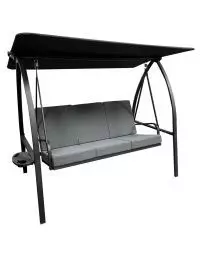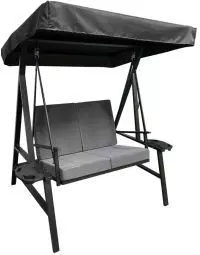
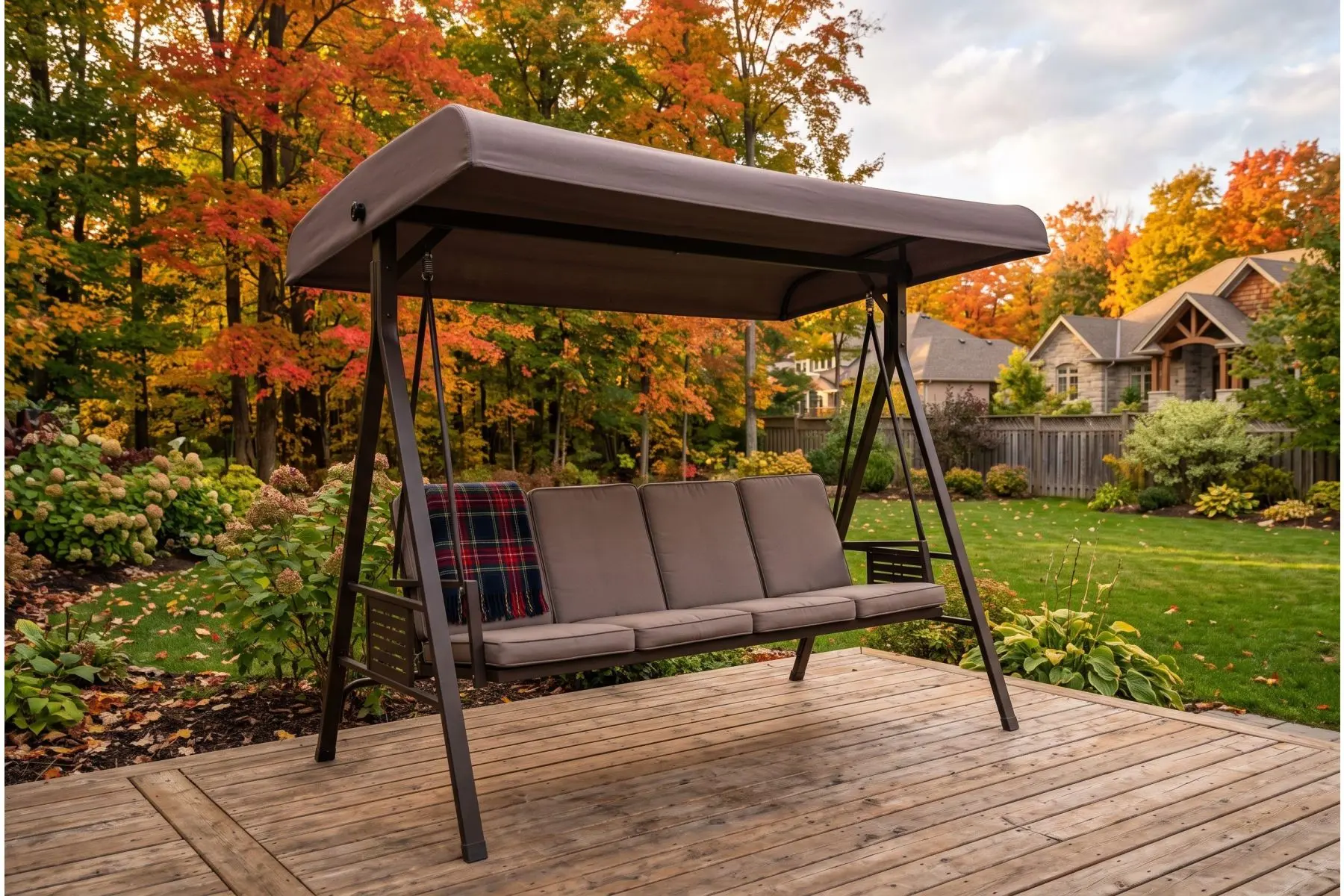
A garden swing is one of the few pieces of patio furniture that people actually use every day of the season. It costs less than a full outdoor sofa set, it needs no cushion-storage bench, and in a Canadian backyard — where the outdoor living season runs from roughly May to early October — it delivers shade, seating and a canopy in one purchase. The hard part is choosing between a two-seater and a four-seater, and between a classic hanging swing and a glider. This guide walks through sizing, motion, materials, budget and off-season care, using the measurements and prices from our own catalogue rather than generic advice.
Why a garden swing still earns its spot in a Canadian backyard
Canadians get a short outdoor season and a lot of weather inside it. A garden swing handles that better than most seating because the canopy is part of the furniture: you get sun protection at midday in July and a dry seat after a light shower in September, without putting up a separate shade structure. In cities like Ottawa, Montreal and Toronto — where a typical suburban deck is 12 by 16 feet and already crowded — a swing also replaces three or four separate chairs with one footprint.
It is worth being clear about what a swing is not. It is three-season furniture. The canopies on these frames carry no snow-load rating, unlike the engineered roof on a hardtop gazebo, so a swing is something you enjoy from May through October and then take down or cover. Plan for that from day one and the purchase makes sense; ignore it and you will be replacing a canopy after the first heavy January snowfall.
Two, three or four seats: what each size actually needs
Seat count is the first decision and the one buyers most often get wrong, because a two-seater does not shrink the way people expect. Sojag lists the Eco 2-Seater Garden Swing at 104.72 x 24.92 x 74.21 inches and the Eco 4-Seater Garden Swing at 104.3 x 41.1 x 74.6 inches. The long dimension is effectively identical — about 8 feet 9 inches — because the A-frame legs splay to the same span on both. What you save by dropping to two seats is depth, not width.
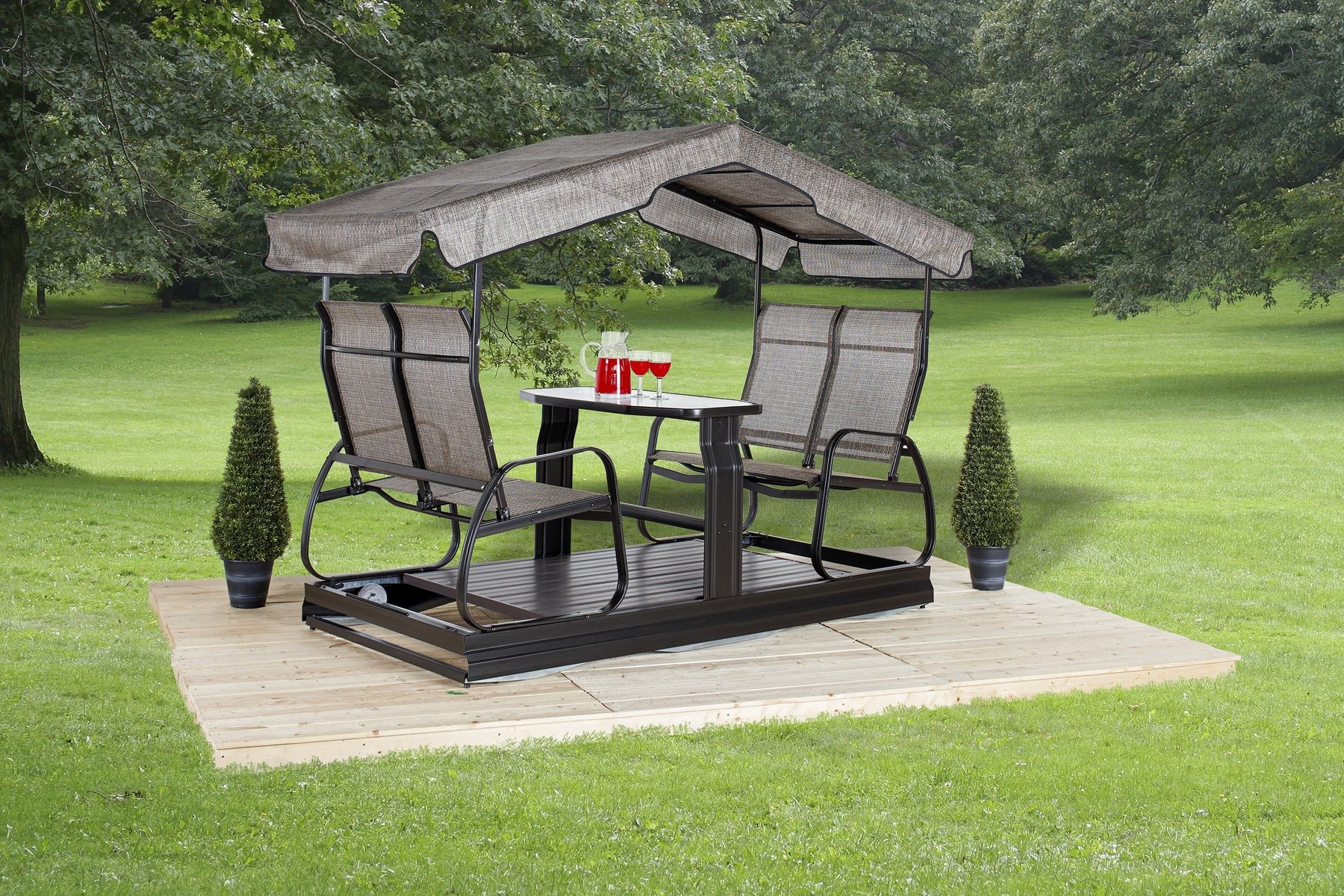
The practical rule: measure a clear run of roughly 9 feet for any of these frames, allow about 6 feet 3 inches of headroom, and then leave a further two feet clear at the front and back so the seat can actually travel without knocking into a railing or a planter. If the 9-foot run is the problem rather than the depth, look at a glider instead — the Sojag Carleton 4 Seater Garden Glider is listed at 88 x 44.1 x 75.7 inches, which is a foot and a half shorter in its longest dimension while still seating four, with a 34.9-inch seat width.
Three-seaters occupy a genuinely useful middle ground and are where the Corriveau range sits. The Deluxe three-seater swing with cushions and side tables gives you a third seat plus integrated tables, so you are not adding a side table to the deck afterwards.
| Model | Seats | Listed size (in) | Shipping weight | Price |
|---|---|---|---|---|
| Sojag Belle Steel Glider | 1 | Compact glider chair | Light | $120 |
| Sojag Bahia Aluminum Gliding Bench | 2 | Bench glider, no canopy | Light | $273 |
| Corriveau Deluxe two-seater with side table | 2 | With integrated table | 105 lb | $759 |
| Corriveau Deluxe three-seater with side tables | 3 | With integrated tables | 110 lb | $999 |
| Sojag Houston 2-Seater Glider Swing | 2 | 104.73 x 28.74 x 74.35 | 192.9 lb | $1,059 |
| Sojag Eco 2-Seater Garden Swing | 2 | 104.72 x 24.92 x 74.21 | 201.7 lb | $1,130 |
| Sojag Carleton 4 Seater Garden Glider | 4 | 88 x 44.1 x 75.7 | 263 lb | $1,300 |
| Sojag Eco 4-Seater Garden Swing | 4 | 104.3 x 41.1 x 74.6 | 250.6 lb | $1,304 |
| Corriveau Deluxe three-seater hammock-swing | 3 | Converts to a hammock | 204.6 lb | $2,199 |
Swing or glider? The motion changes the furniture
A classic garden swing hangs the bench from the frame, so it moves in an arc: a longer, looser motion that most people find more relaxing and that children invariably prefer. A glider runs the seat on a linked mechanism so it travels forward and back on a level plane. The difference matters more than the marketing suggests.
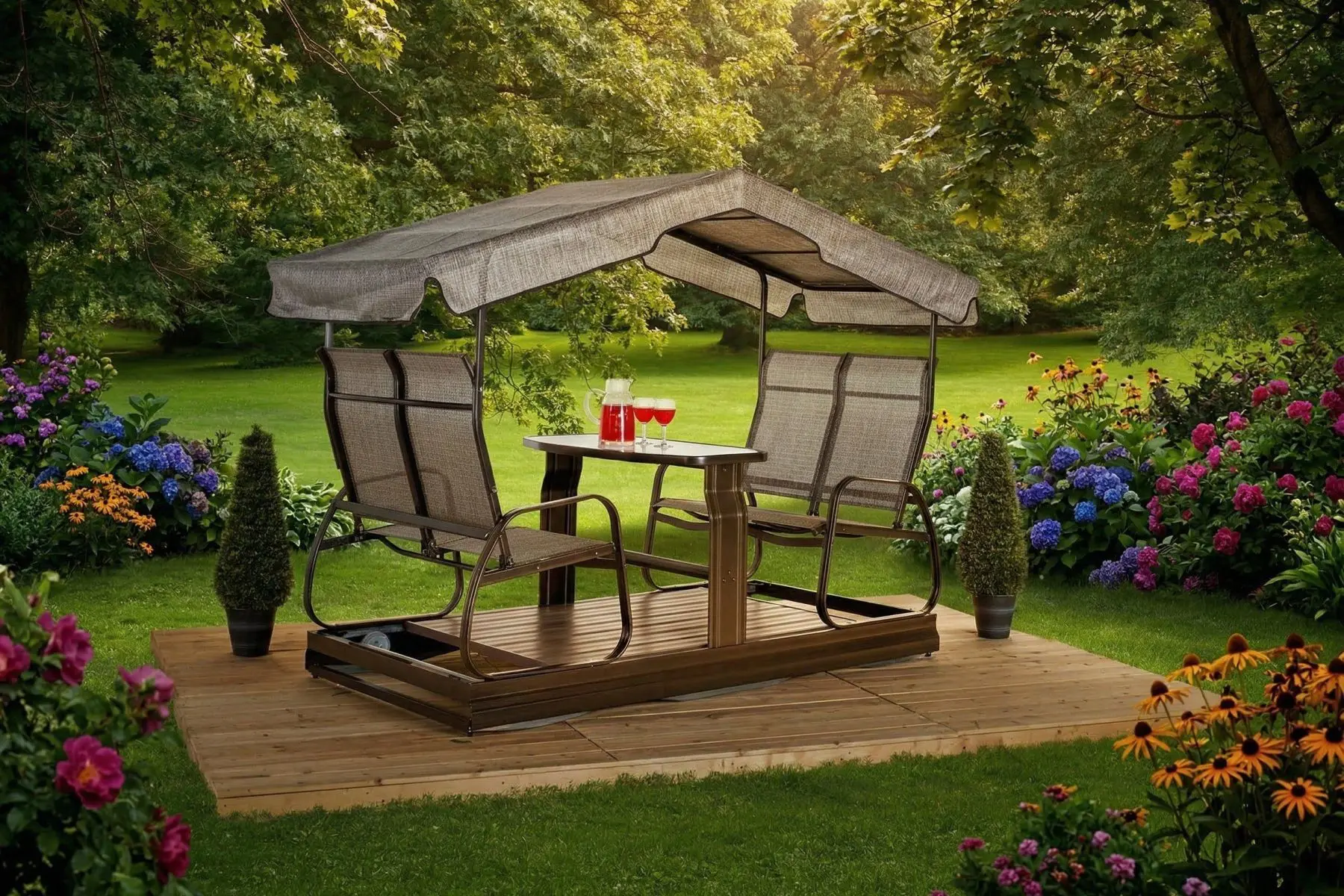
Choose a hanging swing if the swing is going in open lawn or on a generous deck, if you want the classic porch-swing feel, and if the canopy is part of the appeal. The Sojag Eco 2-Seater Garden Swing and Eco 4-Seater Garden Swing are the straightforward picks here, both with a PVC-coated polyester canopy overhead.
Choose a glider if the space is tight, if the ground is uneven, or if anyone using it has mobility concerns — the level motion is much easier to sit down into and stand up from than a seat that swings away as you lower yourself. The Sojag Houston 2-Seater Glider Swing covers the two-seat case, and the Carleton handles four. At the small end, single and two-seat glider chairs such as the Bahia aluminum models start at well under $300, which is a sensible way to add gliding seats around an existing patio furniture arrangement without committing to a full canopy frame.
One in-between option deserves a mention: the Corriveau Deluxe three-seater hammock-swing converts between a bench and a flat hammock. At $2,199 and 204.6 pounds across two boxes it is the premium end of the range, but it is the only model here that does both jobs.
Frames, fabrics and finishes that survive a Canadian season
Three material details separate a swing that looks good in year five from one that does not.
Products in this guide
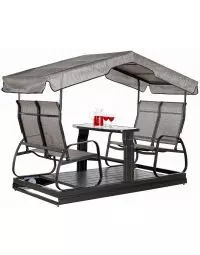
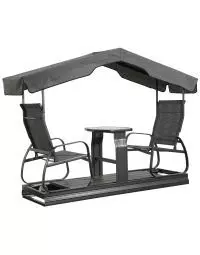
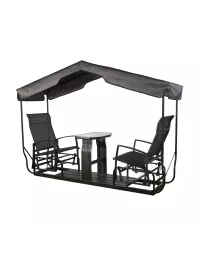
The frame coating. The Sojag Eco line and the Carleton glider use an AkzoNobel Interpon powder coating, which is the industry-standard finish for resisting scratches and corrosion on outdoor steel and aluminum. This matters most where road salt travels — a swing on a front porch in Quebec City or Halifax sees far more salt spray than one in a fenced Calgary backyard.
Steel versus aluminum. Aluminum frames, like the Houston glider and the Bahia models, will not rust if the coating is scratched and are dramatically easier to move in the spring. Steel frames are heavier and more stable in wind — relevant if your yard is exposed. Weight is a fair proxy: the Eco 4-seater ships at 250.6 pounds, which is reassuring on a windy day and awkward on assembly day.
Canopy and seat fabric. PVC-coated polyester, used on the Sojag seats and roofs, repels water and resists the UV fading that turns untreated fabric chalky in two summers. Whatever the fabric, the canopy is the first component to age, so check that a replacement canopy is available for the model before you buy — that single question separates a five-year swing from a two-year one.
What your budget buys, from $120 to $2,200
The range in this category is wide, and the tiers are genuinely different products rather than the same thing at different prices.
Under $300. Glider chairs and benches without canopies — the Belle steel glider at $120, the Bahia aluminum glider around $190, the Bahia gliding bench at $273. These are seating, not shade. They are the right call if you already have a gazebo or pergola overhead.
$750 to $1,000. The Corriveau Deluxe two-seater at $759 and three-seater at $999, both with cushions and integrated side tables. Lighter frames (105 and 110 pounds) make these the easiest full-size swings to handle, and the built-in tables genuinely reduce deck clutter.
$1,000 to $1,350. The canopy swings and four-seat gliders: Houston at $1,059, Eco 2-Seater at $1,130, Carleton glider at $1,300, Eco 4-Seater at $1,304. This is the sweet spot for a household that wants shade included and expects the swing to be the main seating on the deck.
Above $2,000. The convertible hammock-swing, for buyers who want the second function.
Budget one more line item regardless of tier: a mosquito net. Sojag sells nets sized to the 4-seater and to the 2-seater Eco II at $90 each, and Corriveau offers one at $159. In Ontario and Quebec in June and July, this $90 accessory is the difference between using the swing after dinner and looking at it.
Delivery, assembly and putting it away for winter
These are heavy freight items. Most models here ship in a single box — the Eco 4-seater's 250 pounds arrives as one box, which is a two-person unload and worth arranging before the delivery date. Only the Corriveau hammock-swing splits across two boxes. Assembly is a straightforward bolt-together job, but plan on two people and two to three hours for a full-size canopy swing, and assemble it close to where it will live rather than carrying a built frame through a gate.
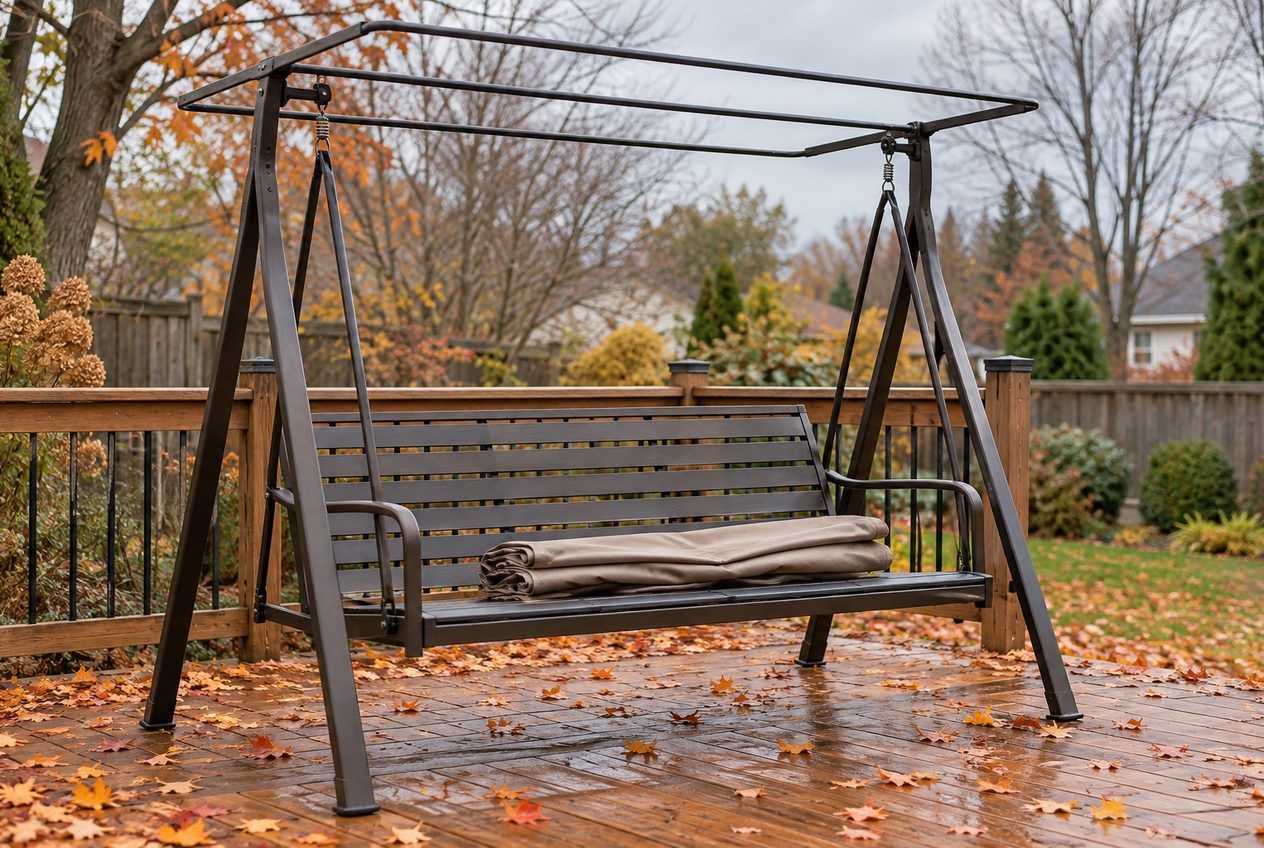
Placement rules that save trouble later: set the frame on a level surface, keep the two feet of front-and-back clearance mentioned above, and if your deck sits high or your yard is exposed, anchor the legs. A garden swing with a canopy is effectively a sail, and an unanchored frame can walk or tip in a summer storm.
For the off-season, treat the swing the way you would treat any canopy structure. Take the canopy and cushions off before the first lasting snow, store the fabric dry and indoors, and either cover the frame or move it against a wall. Cushions left out over a Canadian winter absorb meltwater, freeze and split their seams — the single most common reason people replace a swing that is otherwise fine.
Frequently Asked Questions
How much space do I need for a garden swing?
Plan for a clear run of about 9 feet and roughly 6 feet 3 inches of headroom. Sojag's Eco 2-Seater and Eco 4-Seater are both listed around 104 inches in their long dimension, so a two-seater saves you depth rather than width. Add two feet of clearance front and back so the seat can travel freely. If a 9-foot run will not fit, a glider such as the Carleton at 88 inches is more compact.
Can I leave a garden swing outside all winter in Canada?
No. Garden swings are three-season furniture and their canopies carry no snow-load rating. Remove the canopy and cushions before the first lasting snow and store them dry indoors. The powder-coated frame can stay outside if it is covered or moved against a sheltered wall, but leaving fabric out through a Canadian winter will ruin it.
Is a glider better than a hanging swing?
Neither is better outright — they suit different situations. A hanging swing gives the classic arc motion and usually includes a canopy. A glider moves level, which takes less space, works better on uneven ground and is considerably easier to get in and out of, making it the sensible choice for older users or anyone with mobility concerns.
How much should I spend on a garden swing?
Glider chairs and benches without canopies run from about $120 to $273. Full-size swings with cushions and side tables start near $759, and canopy swings and four-seat gliders sit between roughly $1,059 and $1,304. Convertible hammock-swings reach $2,199. Budget an extra $90 to $159 for a mosquito net, which most Canadian buyers end up wanting by mid-June.
Choosing the right garden swing for your yard
Work through it in this order. Measure the clear run first — 9 feet for most canopy frames, less if you go with a glider. Decide whether you need the canopy or already have shade from a gazebo or pergola, because that alone moves you between the $200 tier and the $1,000 tier. Then pick the seat count honestly, remembering that a two-seater saves depth rather than width, and add a mosquito net to the order. Browse the full range of garden swings and hammocks alongside the rest of our patio furniture to compare frames, fabrics and canopy options before the season turns.