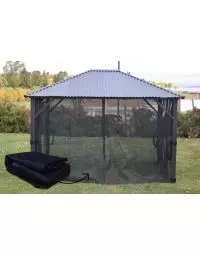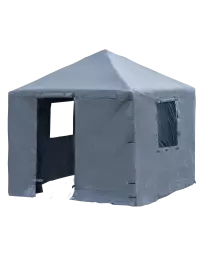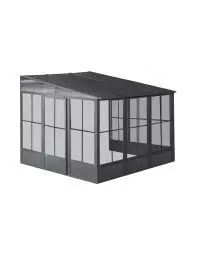
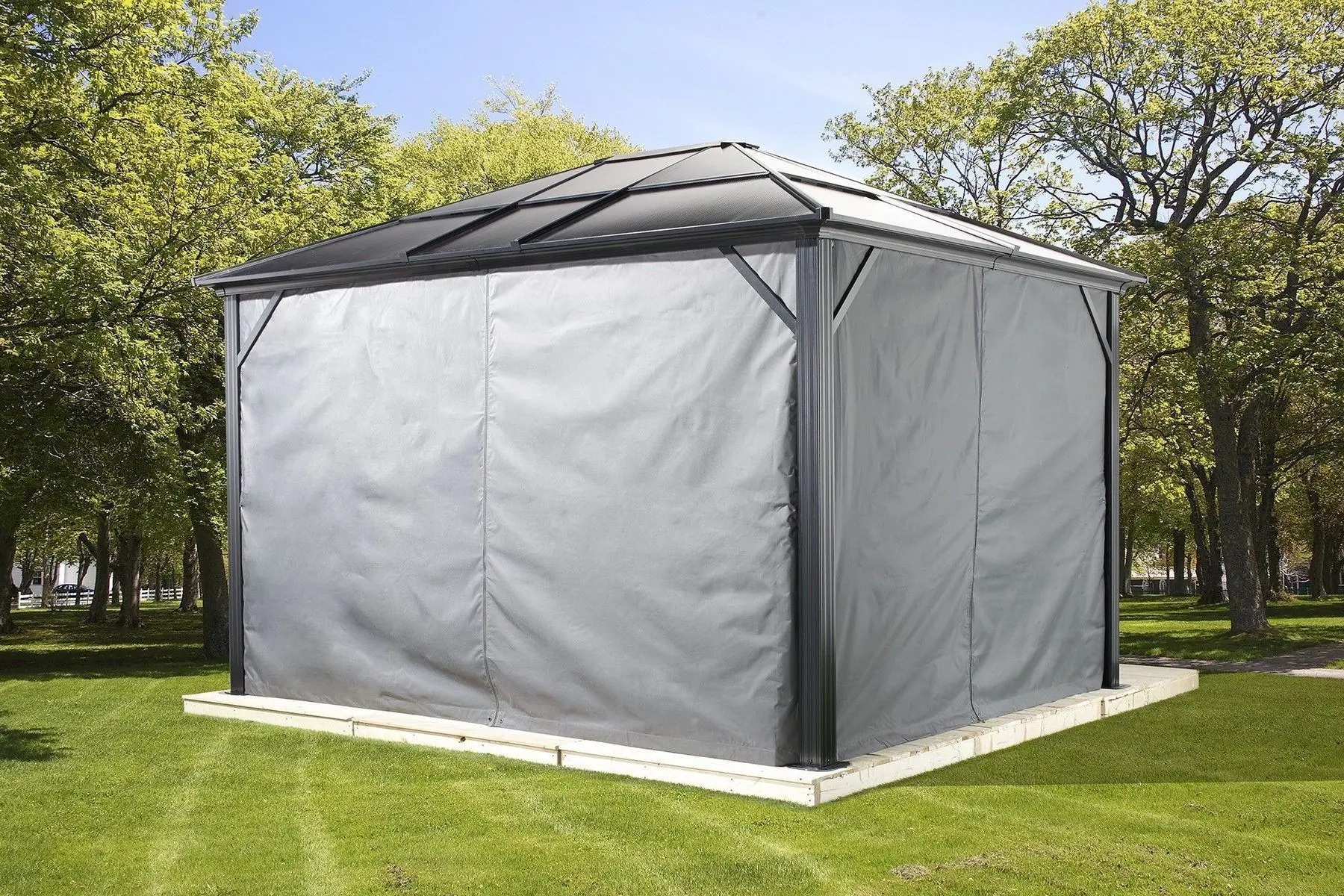
Every October the same question lands in our inbox: can I close in my gazebo and keep using it? In a Canadian backyard the honest answer is that there are four different products doing four different jobs, and buying the wrong one is why so many gazebo curtains end up folded in a box by December. This guide explains what side curtains, mosquito netting, a winter cover and a three-season solarium each actually do, how each one is sized, and which one belongs on your gazebo whether you are in Montreal, Ottawa, Toronto, Winnipeg or Vancouver.
Four ways to close in a gazebo
"Enclosing" a gazebo means something different in July than it does in November. The first decision is not a brand or a colour — it is which season you are buying for, and whether you still want to walk into the space afterwards. Side curtains and netting keep the gazebo usable. A winter cover deliberately takes the space away from you and turns it into protected storage until spring. A solarium is the only one of the four that is a structure rather than an accessory.
| Option | What it blocks | Season it is on | Still usable? | Sized by |
|---|---|---|---|---|
| Side curtains | Wind, rain, low sun, sightlines from the neighbours | Spring to late fall | Yes | Gazebo model and size |
| Mosquito netting | Insects only | Bug season | Yes | Gazebo model and size |
| Winter cover | Snow, ice and winter UV on the roof panels and frame | Late fall to early spring | No — it becomes storage | Footprint and assembled height |
| Three-season solarium | Wind, rain, insects and most of the chill | Up year round, used three seasons | Yes | It is the structure |
Read that table once more before you shop, because the most expensive mistakes we see are category mistakes, not sizing mistakes: a set of curtains bought in the hope it will survive a Quebec winter, or a winter cover bought by someone who wanted to keep eating dinner outside in October.
Side curtains: how they are sized, and the part people forget
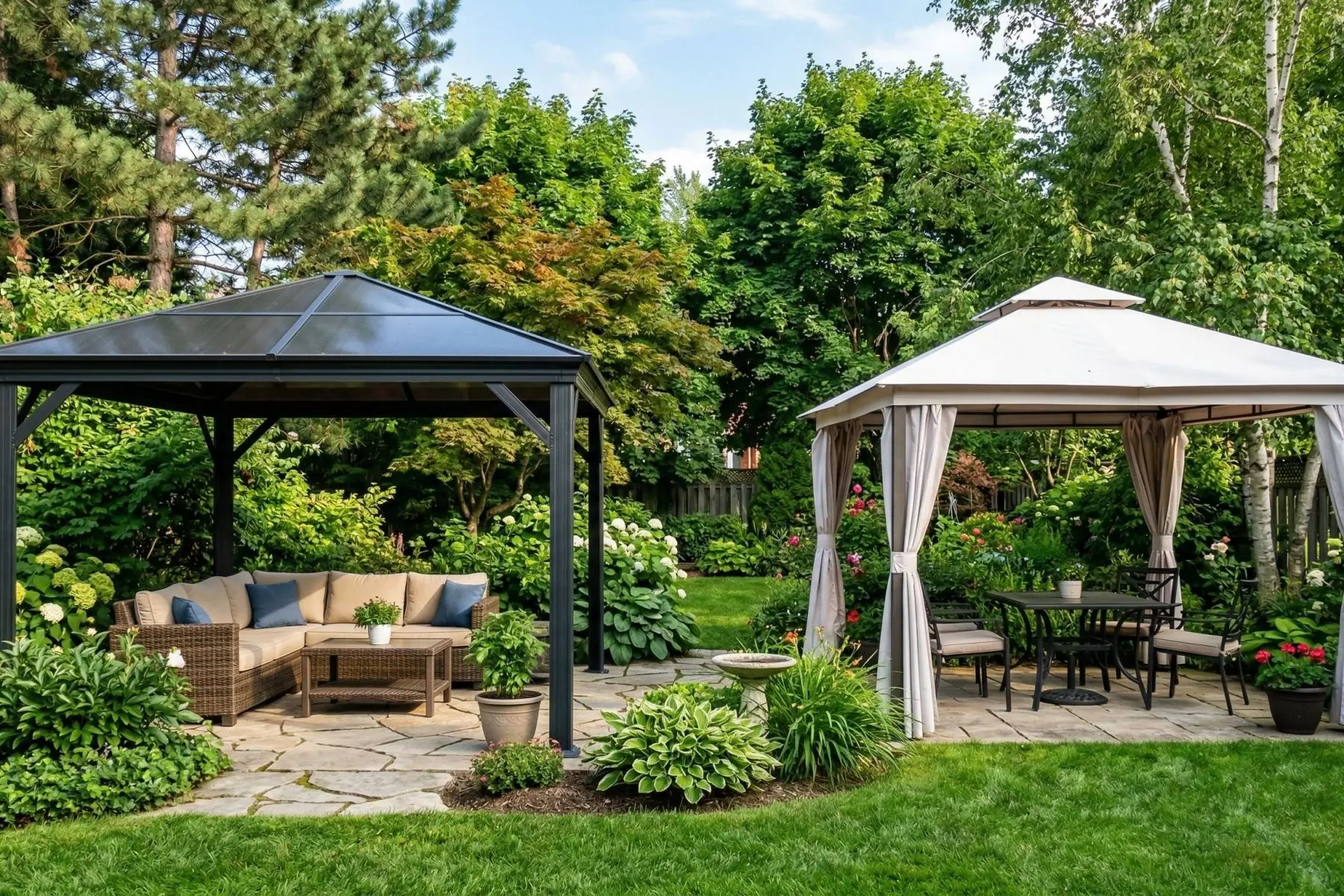
Gazebo side curtains are not generic drapes. They are cut for a specific gazebo model in a specific size, because the hanging system, the post spacing and the height of the beam all change from one model to the next. Sojag sells curtain sets named after the gazebo they belong to — Dakota, Genova, Meridien, Monteserra, Sanibel, Savino, Sumatra, Turia, Ventura, Verona, Dalby, Lena, Skylight, Diani — and a 10 x 12 ft set for one model will not hang correctly on another brand's 10 x 12 ft frame. Before you order anything, find the model name on the label inside the roof or on your original invoice.
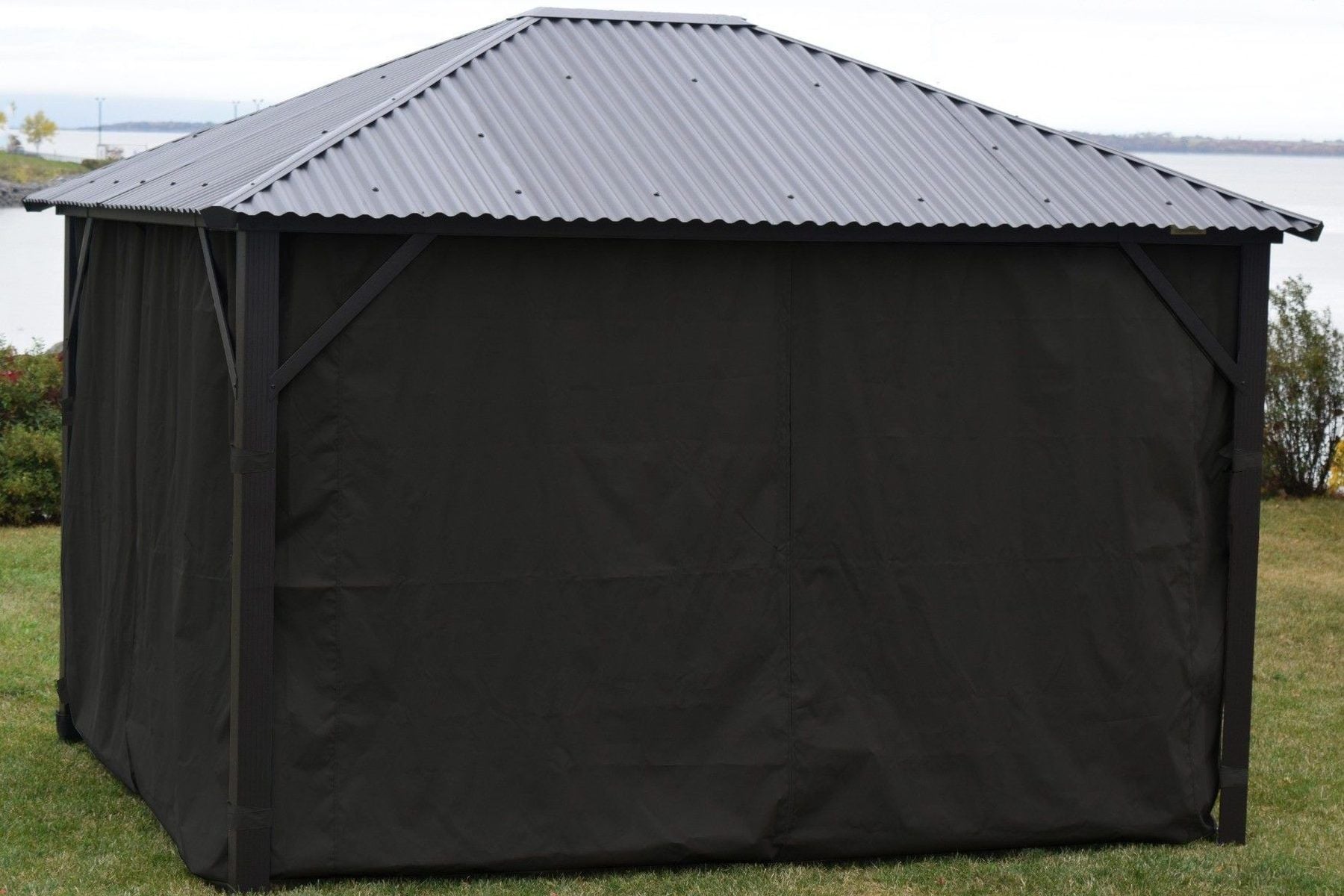
Fabric is the second decision. Sojag's spun polyester sets use a yarn with higher strength and better elastic recovery than conventional polyester, and they include hooks to hang the panels plus zippers so you can close the gazebo completely or open one side for traffic. Corriveau's Safezone curtains take a different approach: the fabric is treated against UV and rated water-resistant to 800 mm, it is CAL-117 fire retardant, and each set is four panels with a double attachment — one strap at the middle of the post and one at the bottom — which is what keeps the panels flat in the wind that funnels between houses on the Prairies.
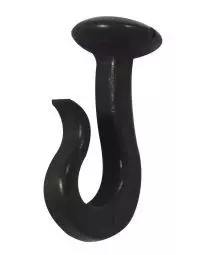
Here is the part people forget. Corriveau side curtains and mosquito nets hang from a hook kit that is sold separately, so a first order that contains only the curtain set will arrive without any way to mount it. Add the Corriveau gazebo hooks at the same time and save yourself a second delivery. Sojag sets include their hooks in the box.
Finally, read what the manufacturers themselves say about the season: remove outdoor curtains during the winter season, and retract them during strong winds. That instruction is printed on the product, not invented by us. Fabric panels left stretched across a frame in a February storm become sails, and the frame — not the fabric — is what pays for it.
Mosquito netting and screen panels: insects, not weather
Netting is the option people most often buy for the wrong reason. It stops black flies and mosquitoes, which in late June in cottage country is worth the whole purchase, but it does nothing about wind, nothing about driving rain and nothing about snow. If your complaint is that the gazebo is unusable at dusk, netting is the answer. If your complaint is that the rain blows sideways onto the table, you want curtains.
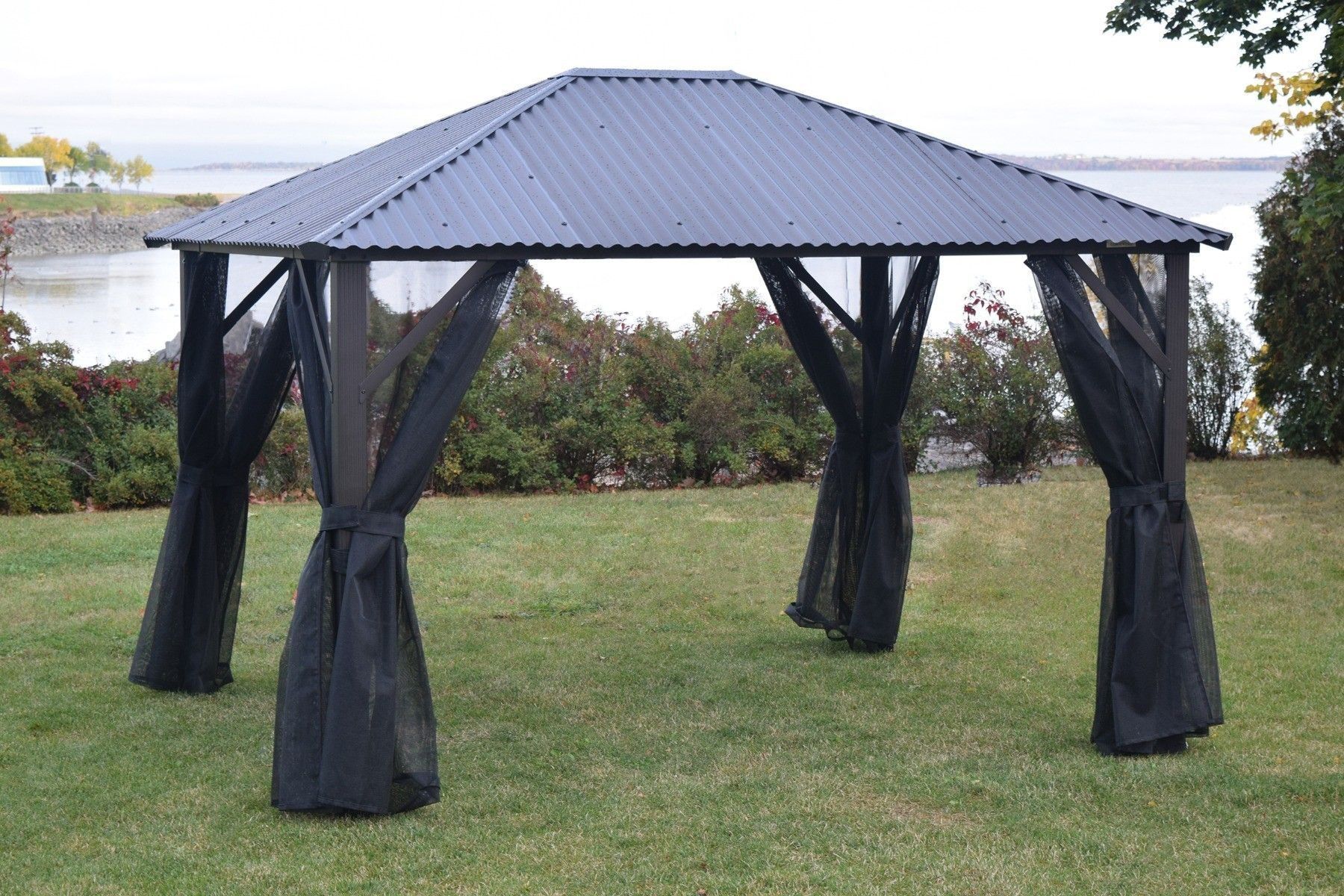
Mosquito netting is sized exactly like curtains — by model and by footprint — and the Corriveau nets use the same four-panel, double-attach system and the same separately sold hook kit as their curtains. That is convenient: one set of hooks carries netting in July and curtains in September.
Two neighbours of the netting family are worth knowing about. If you own a pop-up style canopy rather than a hardtop gazebo, ShelterLogic makes a screen enclosure kit with a zippered door and bungee cords that converts a MaxAP canopy into a screen house. And if the problem is sightlines rather than insects, a privacy panel is a better buy than a curtain: Sojag's Hilo fibreglass panel mounts on a pergola through pre-drilled holes and pulls down to whatever height you want, which also works as late-afternoon shade on a west-facing deck.
Winter covers: measure the height before the footprint
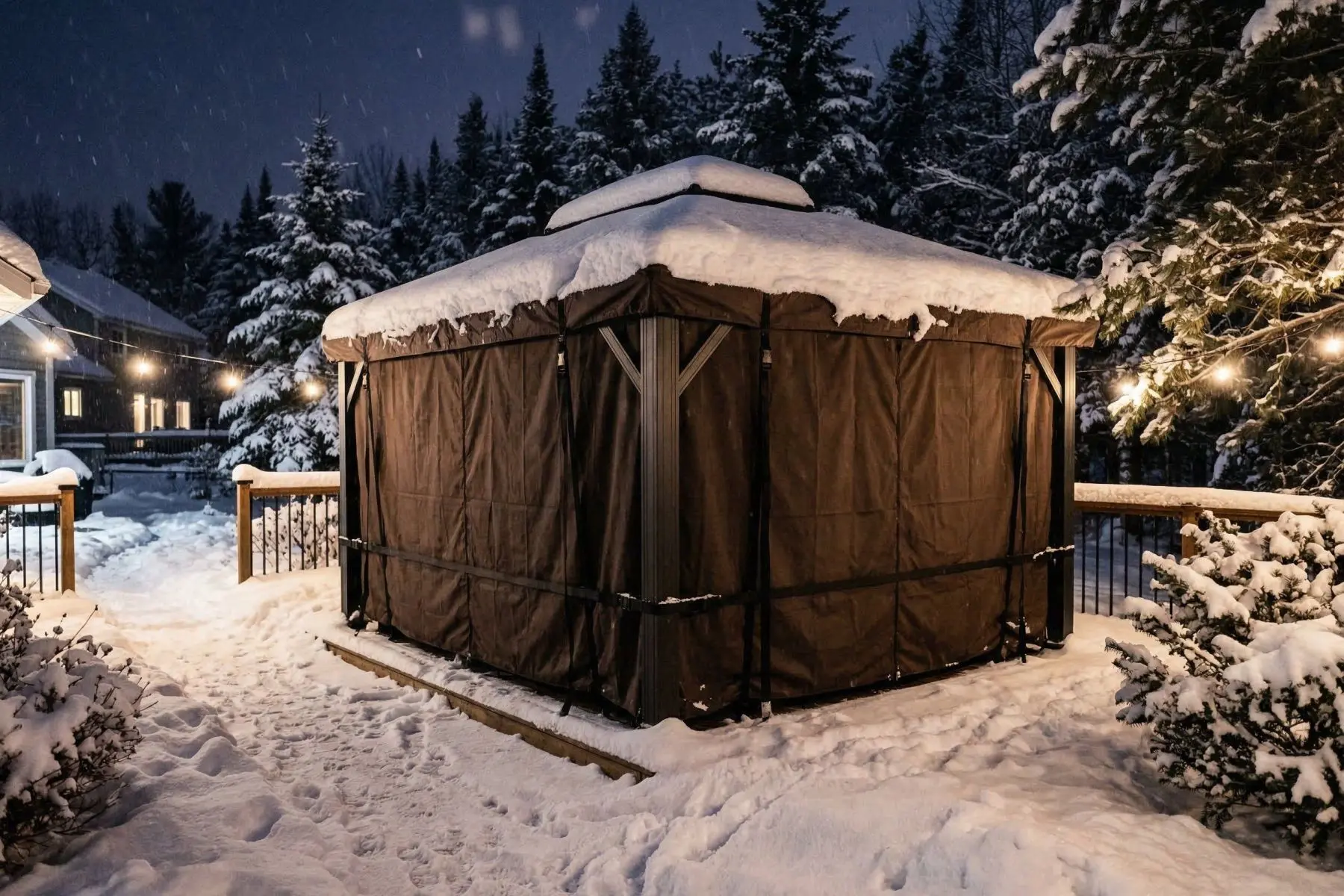
A winter cover is the opposite of a curtain. It is designed to be sealed over the whole gazebo from late fall until the thaw, so that snow slides off a smooth surface instead of grinding against roof panels, and so the frame spends the winter out of the UV and the freeze-thaw cycle. The space becomes protected storage — patio furniture, the barbecue, cushions — and you do not walk into it again until spring.
Products in this guide
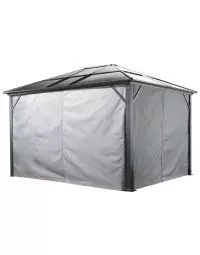
Almost everyone sizes a cover by its footprint and stops there. The footprint is only half the specification. Sojag's Universal Winter Cover is built for free-standing hardtop gazebos with an assembled height under 122 inches, while the Universal Winter Cover Plus exists precisely because the taller models in the range do not fit that first cover — it is cut for gazebos 114 inches and up, and it adds a zippered door so you can get into your own storage in January, plus nylon straps in the box. Both are 200-gram polyethylene with covered vents that let air move while keeping rain and snow out, and both are CPAI-84 fire retardant compliant. Corriveau's covers take a slightly different route: white polyethylene at 185 g/m², one door, Velcro at each extremity to fix to each post, vent holes to cut wind flap and condensation, eyelets so you can anchor the cover to the ground, and a formulation that will not crack in cold weather.
Whatever you buy, add a winter support post. Both brands make an adjustable steel one — Sojag's extends from 78.7 to 118.9 inches and comes with a pre-drilled base and a storage bag, Corriveau's adjusts by rotary screw from roughly 78 to 118 inches — and it stands inside the gazebo pressing up against the roof connector. Corriveau is admirably blunt about what that buys you: the post gives you a delay before you have to clear the roof, and the warranty does not cover a frame that collapses under snow build-up. A cover and a post are not a substitute for walking out with a roof rake after a heavy wet snowfall, which is exactly the snow Ontario and the Maritimes get in February. For the full seasonal routine — cleaning, drainage, timing and the step-by-step install — see our guide to preparing a gazebo for winter in Canada.
See-through walls: what a clear panel really means
Every fall we get searches for a clear or transparent tarp for a 10 x 12 gazebo, and it deserves a straight answer: we do not sell clear vinyl curtain panels, and we would be careful about the ones you find elsewhere. Thin clear PVC goes brittle and milky after a Canadian winter or two, it holds condensation against the frame, and it has the same wind problem as any other fabric panel without the strength to match.
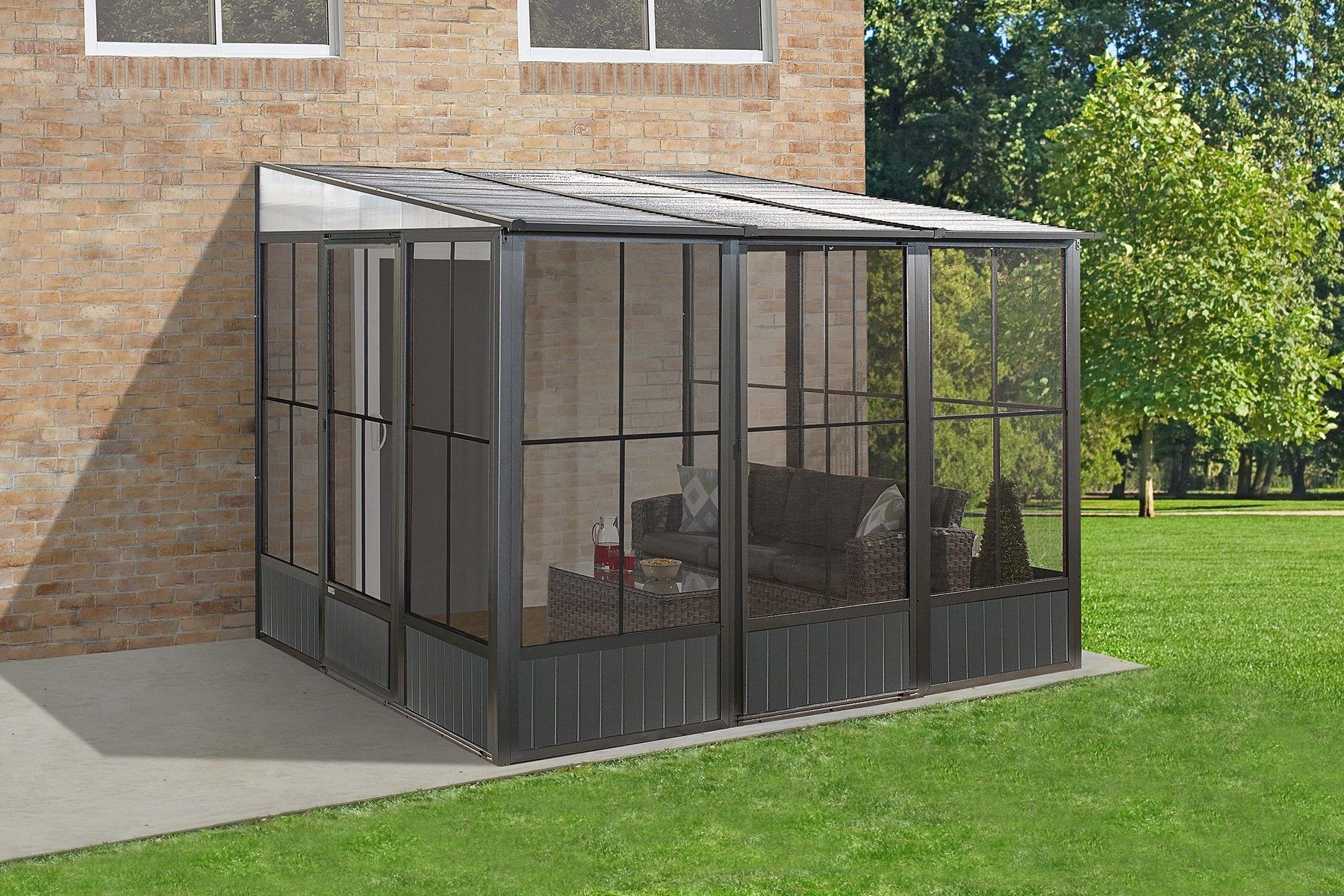
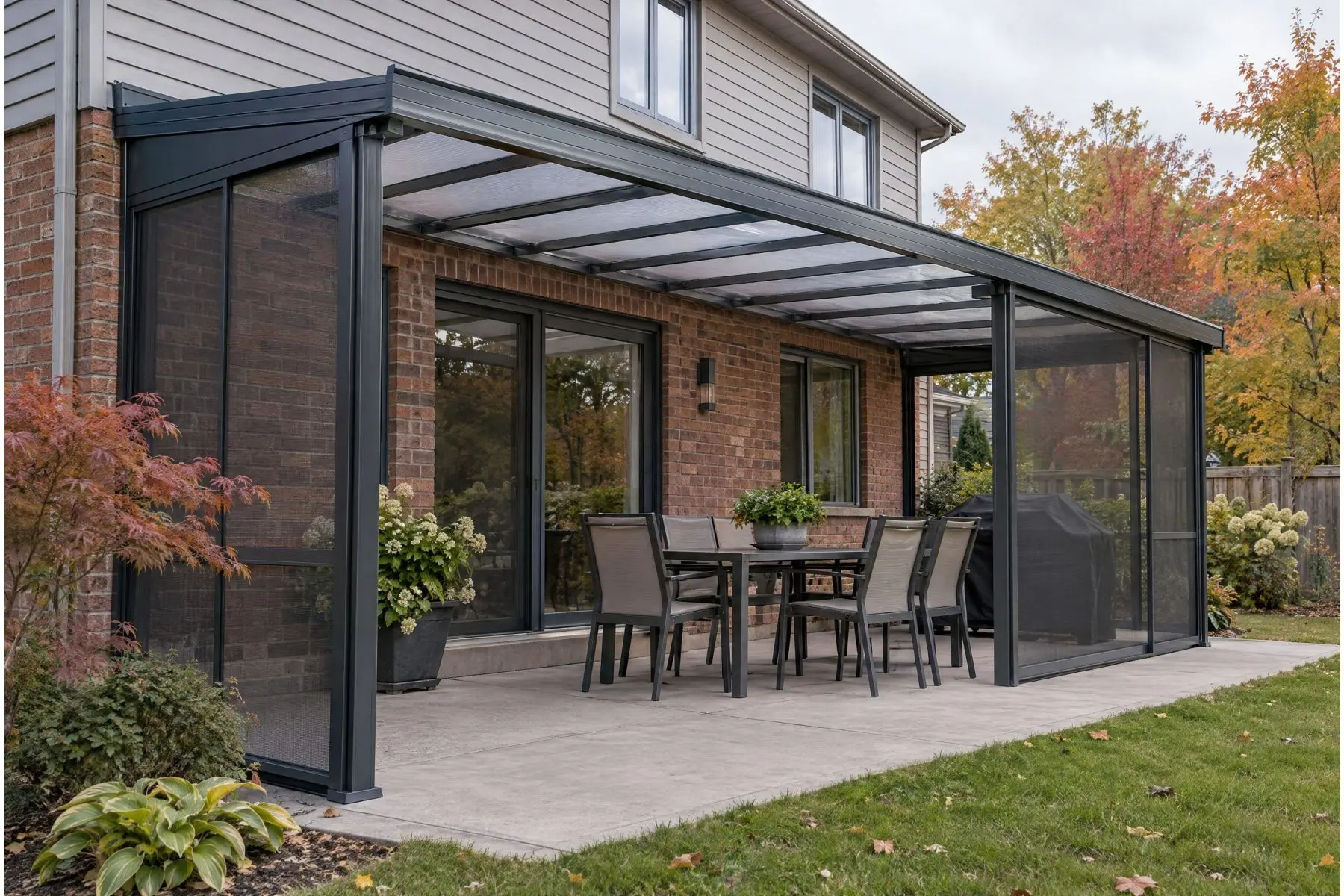
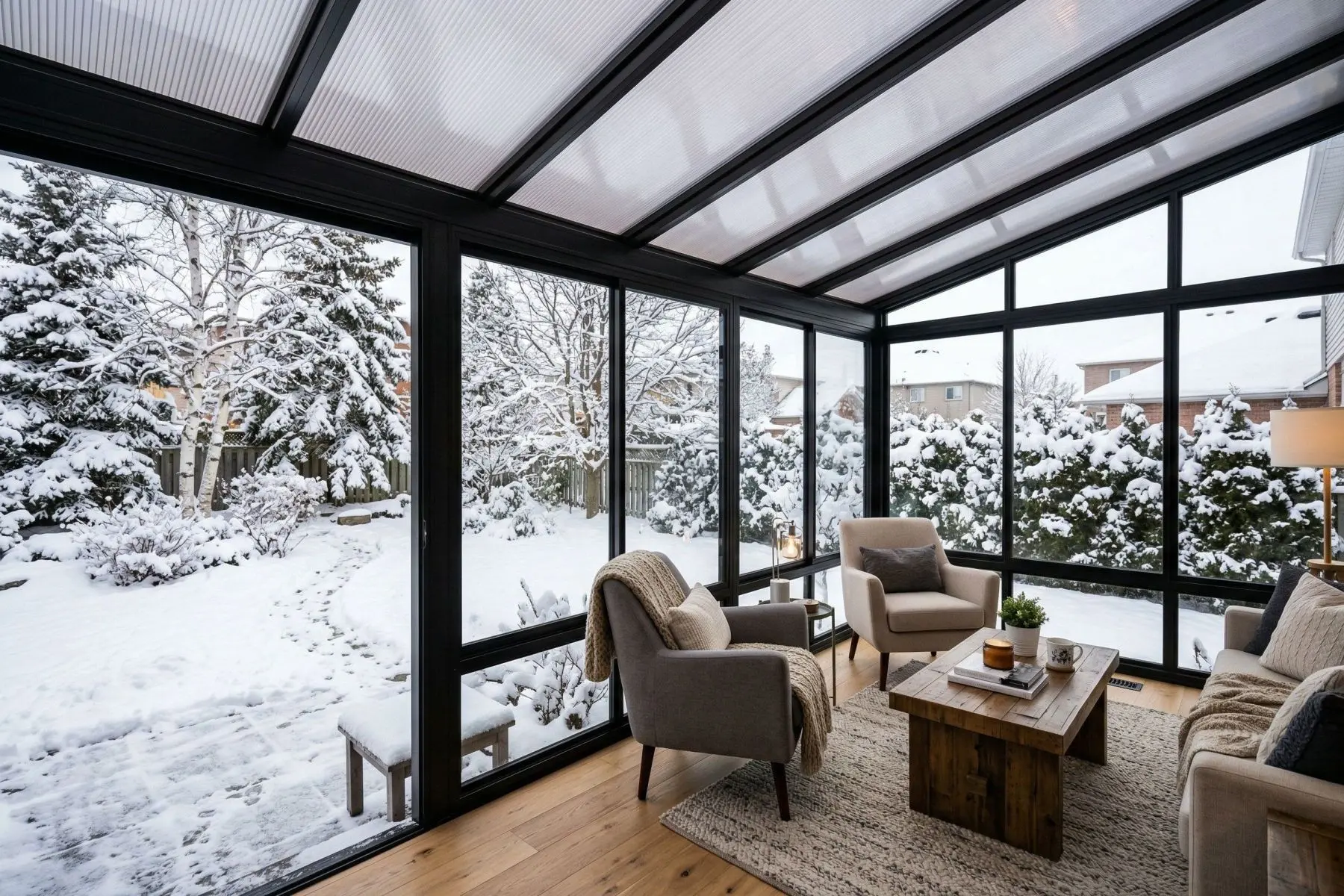
If what you actually want is to sit in your backyard in October and still see the yard, the product is a three-season solarium. Sojag's Korado is extruded aluminum with an Interpon powder coating, a galvanized steel roof, and walls made of screened PVC sliding windows that set in three positions, so you can run it fully closed on a cold evening or wide open with just the screens in July. Gazebo Penguin's Florence Add-A-Room takes the same idea against a house wall: powder-coated aluminum, a reinforced UV-protected polycarbonate roof, two sliding doors you can set to open left or right, and five-position wind panels that slide right down to the base for maximum airflow. Its screening is removable and replaceable if a branch tears it, and the unit is built to stay up year round rather than be dismantled every October.
Two honest caveats. These are three-season rooms, not heated additions — the Florence is explicitly not insulated, and neither is the Korado. And a solarium does not excuse you from winter maintenance: Gazebo Penguin's own instructions say snow accumulation should be cleared. What you are buying is roughly two extra months of usable backyard at each end of the season, with a real roof and real walls, rather than a fabric panel you take down in November.
Frequently Asked Questions
Can I leave gazebo curtains up all winter?
No. The manufacturers' own instructions are to remove outdoor curtains for the winter season and to retract them during strong winds. Fabric panels stretched across a frame act like sails in a winter storm, and the load goes into the posts and roof connectors. Take the curtains down when you install the winter cover, fold them dry, and store them indoors.
Do gazebo curtains come with everything needed to hang them?
It depends on the brand. Sojag curtain sets include four panels and the hooks that hang them. Corriveau side curtains and mosquito nets are four panels with a double attachment at each post, but the hook kit is sold separately, so order the Corriveau gazebo hooks with your first set. The same hooks then carry both your netting and your curtains.
Are there clear or transparent side panels for a gazebo?
Not in our range, and that is deliberate — thin clear PVC clouds, stiffens and tears after a winter or two in this climate. If you want to close the sides in and still see out, the product that does it properly is a three-season solarium with screened PVC sliding windows, such as a Korado, or an add-a-room model with wind panels against your house wall.
Will a winter cover stop snow damage on its own?
No single accessory does. A cover keeps snow, ice and UV off the panels and frame, and an adjustable winter support post under the roof connector buys you time before the roof has to be cleared — Corriveau states plainly that the warranty does not cover a frame that collapses under snow build-up. After a heavy wet snowfall, clear the roof.
Choosing for your backyard
Work backwards from the months you want. If the goal is to eat outside into late September in Toronto or Ottawa without the wind ruining it, buy gazebo curtains for your exact model and keep them for spring through fall. If the goal is to survive the black flies in June, buy mosquito netting and the hook kit that carries both. If the goal is simply to protect the structure and park the patio furniture somewhere dry from November to April, buy the right gazebo winter cover for your footprint and your gazebo's assembled height, add a winter support post, and plan on clearing the roof after the wet storms. And if what you really want is a room — walls, a roof, a view, and two extra months of backyard at each end of a Quebec or Ontario season — you are shopping for solariums, not for gazebo accessories.
Whichever you choose, order in the right month. Curtains and netting sell down over the summer, and covers go first in mid-October through mid-November, which is also the last comfortable weekend to be up a ladder in Montreal.
Reviewed by the IPATIO team, Saint-Laurent, Quebec.