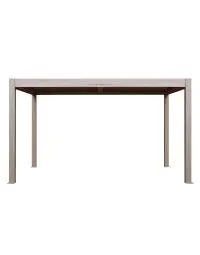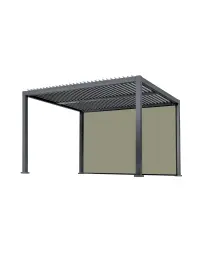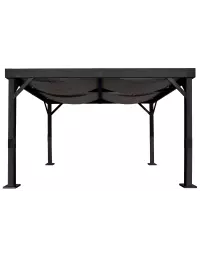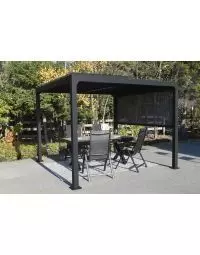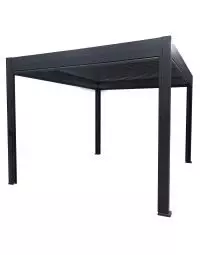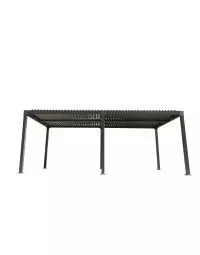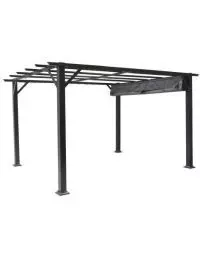
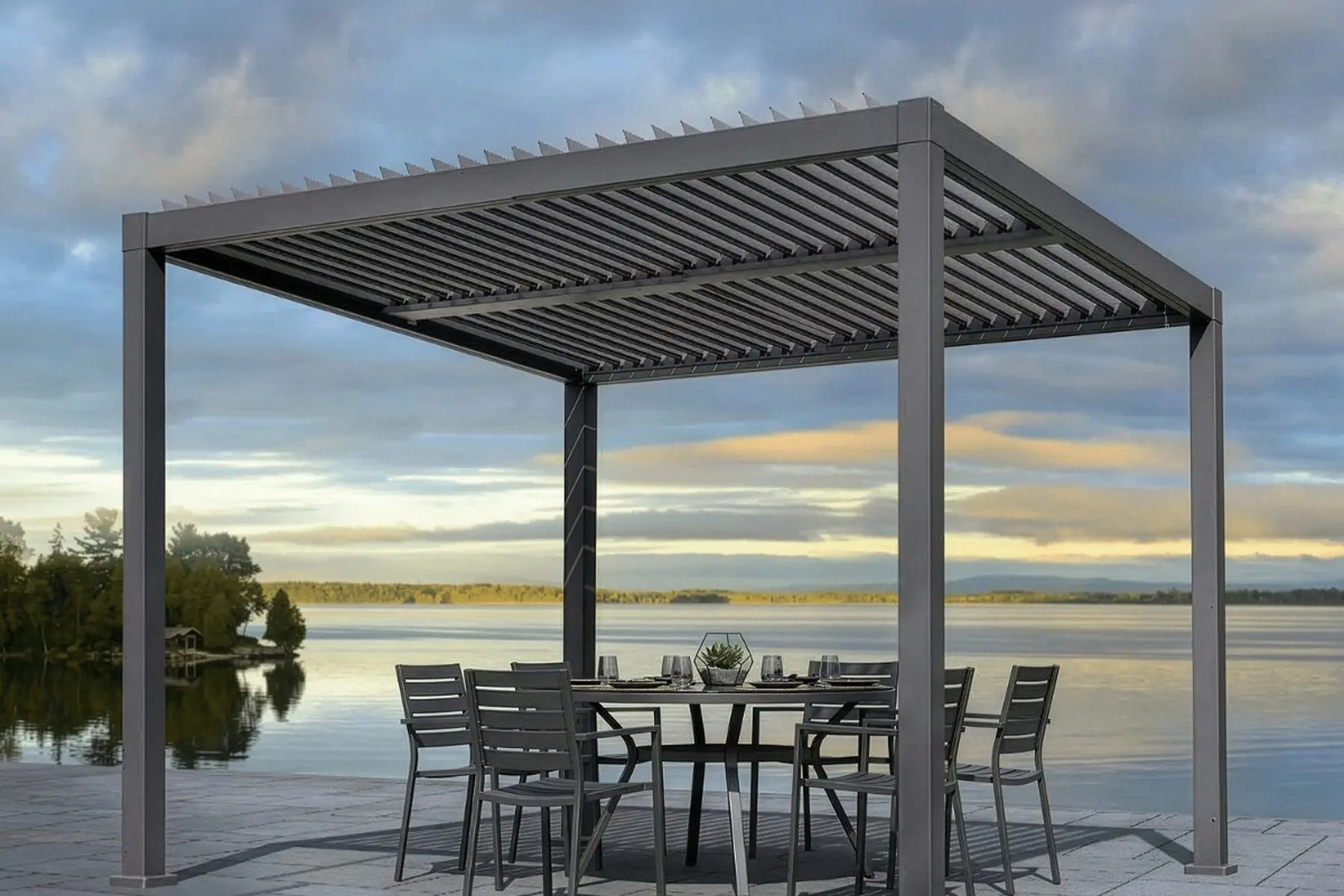
A louvered pergola answers the question Canadians actually ask about outdoor living: can I still sit outside when the forecast is wrong? Instead of a fixed roof or a fabric canopy, the roof is a deck of blades you crank open for full sun, angle for filtered shade, or close completely so rain runs into a gutter built into the beam. That one moving part is why the aluminum pergola has become the structure people shop for once they have lived through a summer of cancelled dinners. This guide explains how an adjustable louvered roof works, how much space a pergola really covers once the posts are in the way, which models we stock in Canada, and the honest limits of a louvered roof between November and April.
The short answer
Choose a louvered pergola if you want shade you can change by hand through the day and a roof that keeps an afternoon shower off the table. Choose a fabric-roof or retractable-canopy pergola instead if shade is all you need and you are happy to take the roof down before winter. Either way, plan around the covered area between the posts rather than the name on the box: a model sold as 10 × 10 ft gives you roughly 8 ft 11 in square of usable space underneath, and about 7 ft of clear height under the beams.
How an adjustable louvered roof actually works
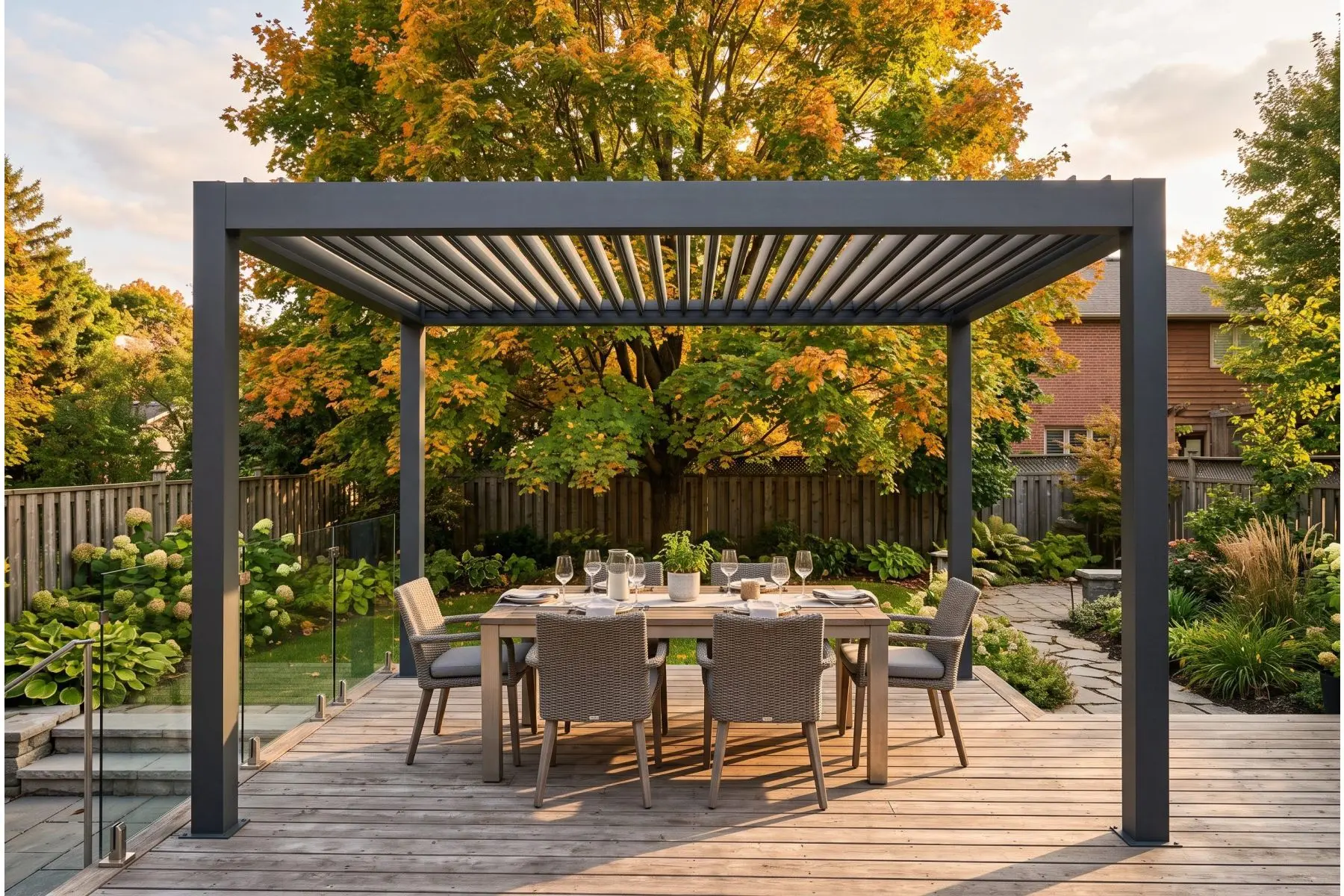
The roof is made of blades mounted in an aluminum frame, in two sections on most models. A hand crank turns a linkage that rotates every blade in a section at once, so you can run one half open and one half closed — sun on the lounge chairs, shade over the table. The Corriveau Glendale is the exception: its blades run the full length of the roof and turn as one. There is no motor and no wiring on the models we sell, which means no electrician, no permit for a circuit, and nothing to fail in a power cut. Sojag and Gazebo Penguin ship the cranks in the box: the Sojag Hilo package contains the structure, the louvered roof kit, two hand cranks, the hardware and the manual.
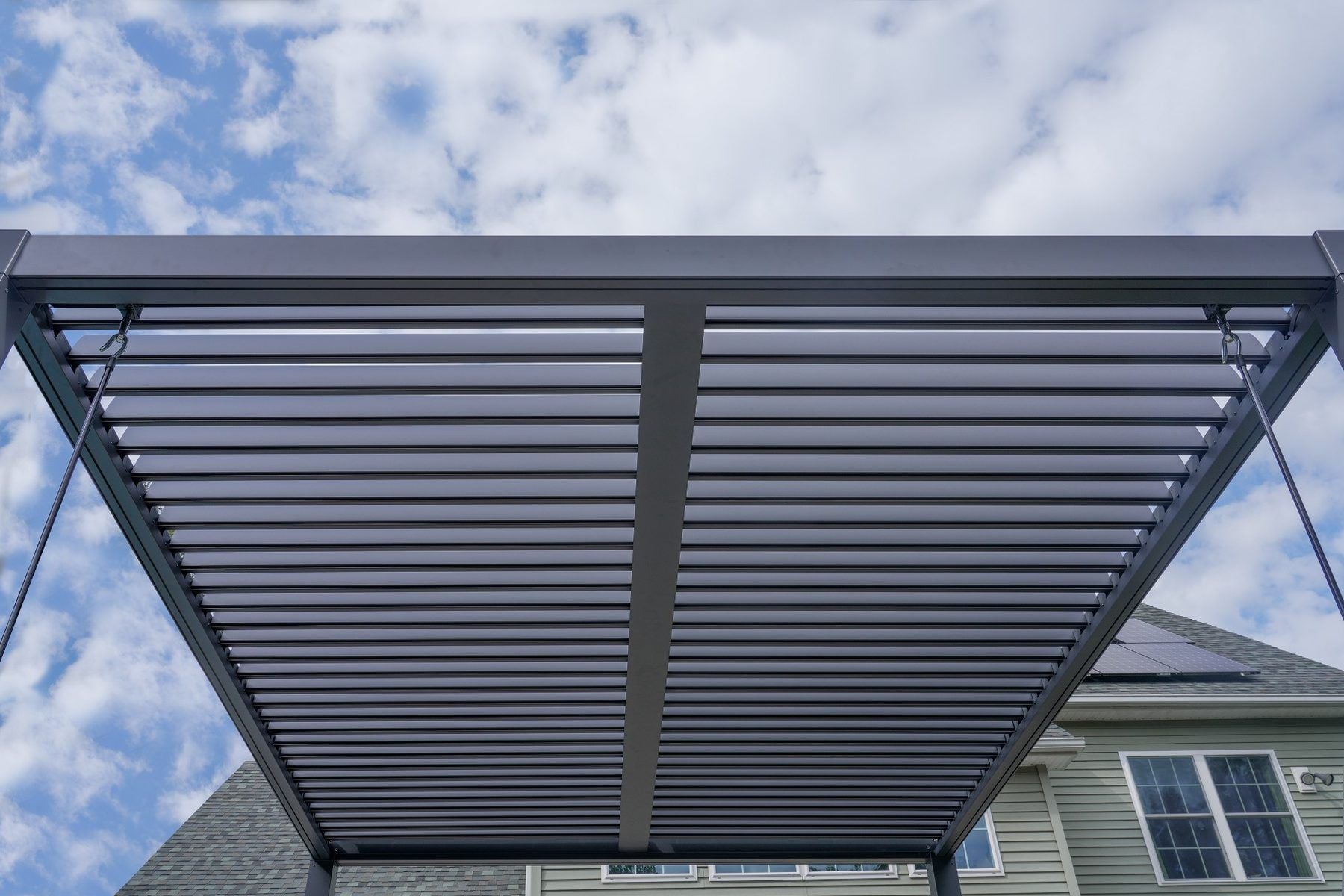
When the blades close, they overlap into a continuous surface and water runs along the inside of each blade into a gutter integrated in the beam, then down through a post. It is a genuinely useful system in a Montreal or Toronto summer, where a thunderstorm arrives in twenty minutes and is gone in thirty. It is not a sealed roof, though, and the catalogue does not list any of these models as waterproof: expect drips at the seams in a sustained downpour and plan the furniture accordingly. Think of it as a roof that moves water away rather than one that locks it out.
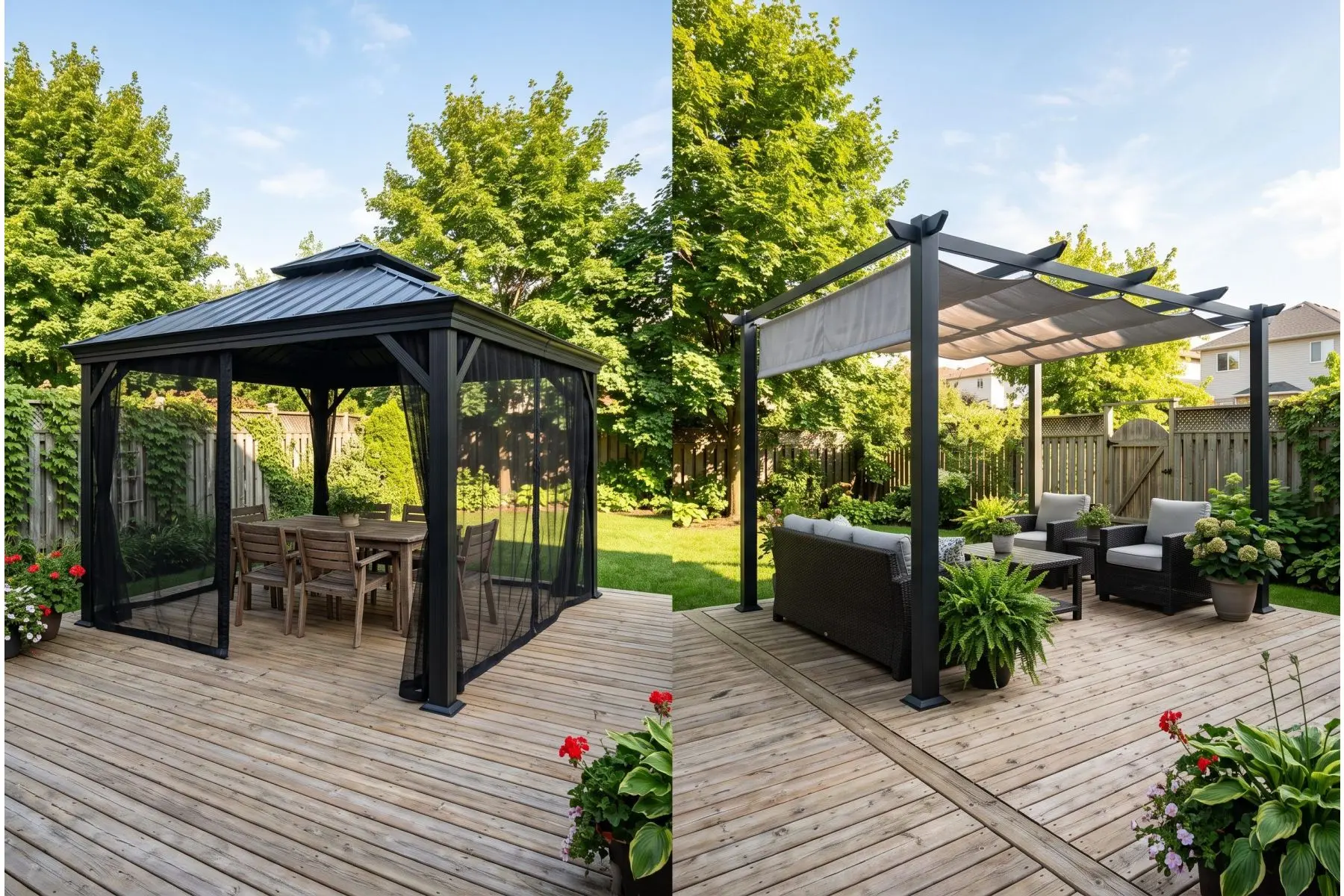
Louvered, retractable canopy or fabric roof?
Pergolas in Canada come in three practical flavours, and the differences matter more here than in a milder climate because our season is short and our weather changes quickly.
| Roof type | Shade control | Rain | End of season | Models we stock |
|---|---|---|---|---|
| Adjustable louvers | Infinite, by crank (two sections on most models) | Runs off into an integrated gutter | Stays up; open the blades | Sojag Hilo, Gazebo Penguin Vikos, Corriveau Casilda, Corriveau Glendale |
| Retractable canopy | Open or closed, no angles | Light rain only | Retract and store the fabric | Corriveau San Luis, Corriveau Marina |
| Fixed fabric roof | Fixed, full shade underneath | Light rain only | Remove the fabric roof | Sojag Fontana, Sojag Lima, Sojag Dunwich |
The trade-off is weight and handling, not just capability. A fabric-roof Sojag Fontana 10 × 12 ft arrives as a single carton of about 232 lb; the louvered Sojag Hilo 10 × 20 ft arrives as five cartons totalling about 498 lb. More blades mean more aluminum, more hardware and more assembly time.
The louvered pergolas we stock in Canada
We carry three louvered lines, and they are built differently in ways worth knowing before you choose. The Sojag Hilo uses aluminum louvers on an extruded aluminum frame with a powder-coated finish, in grey, at 10 × 10 ft and 10 × 20 ft. The Gazebo Penguin Vikos uses galvanized steel louvers 0.7 mm thick on a powder-coated aluminum frame, at 10 × 10 ft and 10 × 13 ft, in grey, greige and a wood finish. Steel blades are stiffer and heavier: a Vikos 10 × 10 ft ships at about 494 lb against roughly 309 lb for a Hilo of the same nominal size.
The third line is Corriveau, a Quebec brand, and it is the one to look at if you want black rather than grey, or a size the other two do not offer. The Casilda comes as 10 × 10 ft, 10 × 13 ft and 10 × 20 ft on 4 in square aluminum posts, with the blades split into two banks like the Hilo and the Vikos. The Glendale is a 10 × 13 ft on heavier 5 in posts, and its blades run the full length of the roof and turn as one — simpler, but you give up the half-sun, half-shade trick. Both drain through gutters built into the beam and out through a post, both have four anchor holes at the base of every post, and Corriveau quotes about four hours of assembly. Availability on this line moves through the season, so check the product page for the size you want.
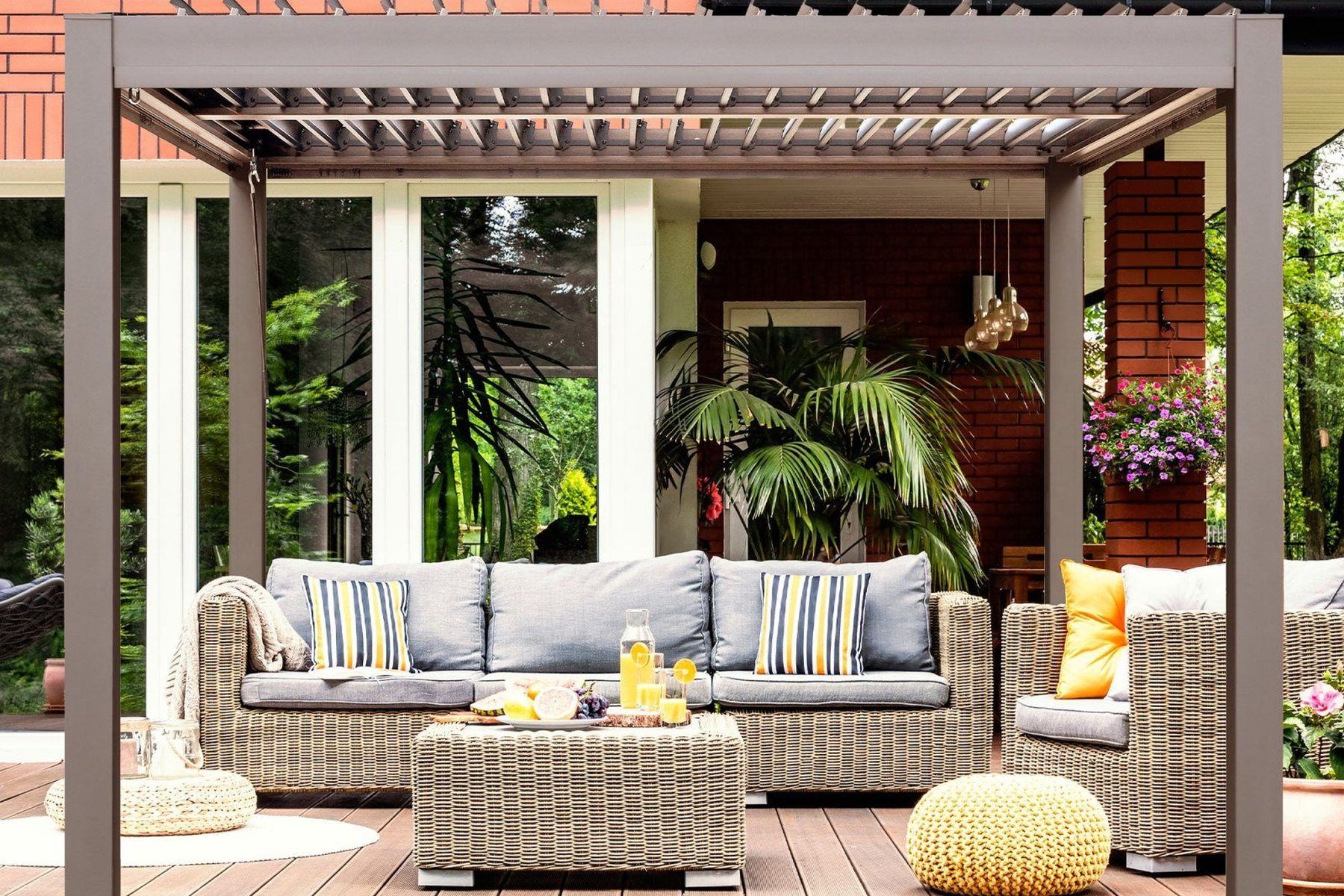
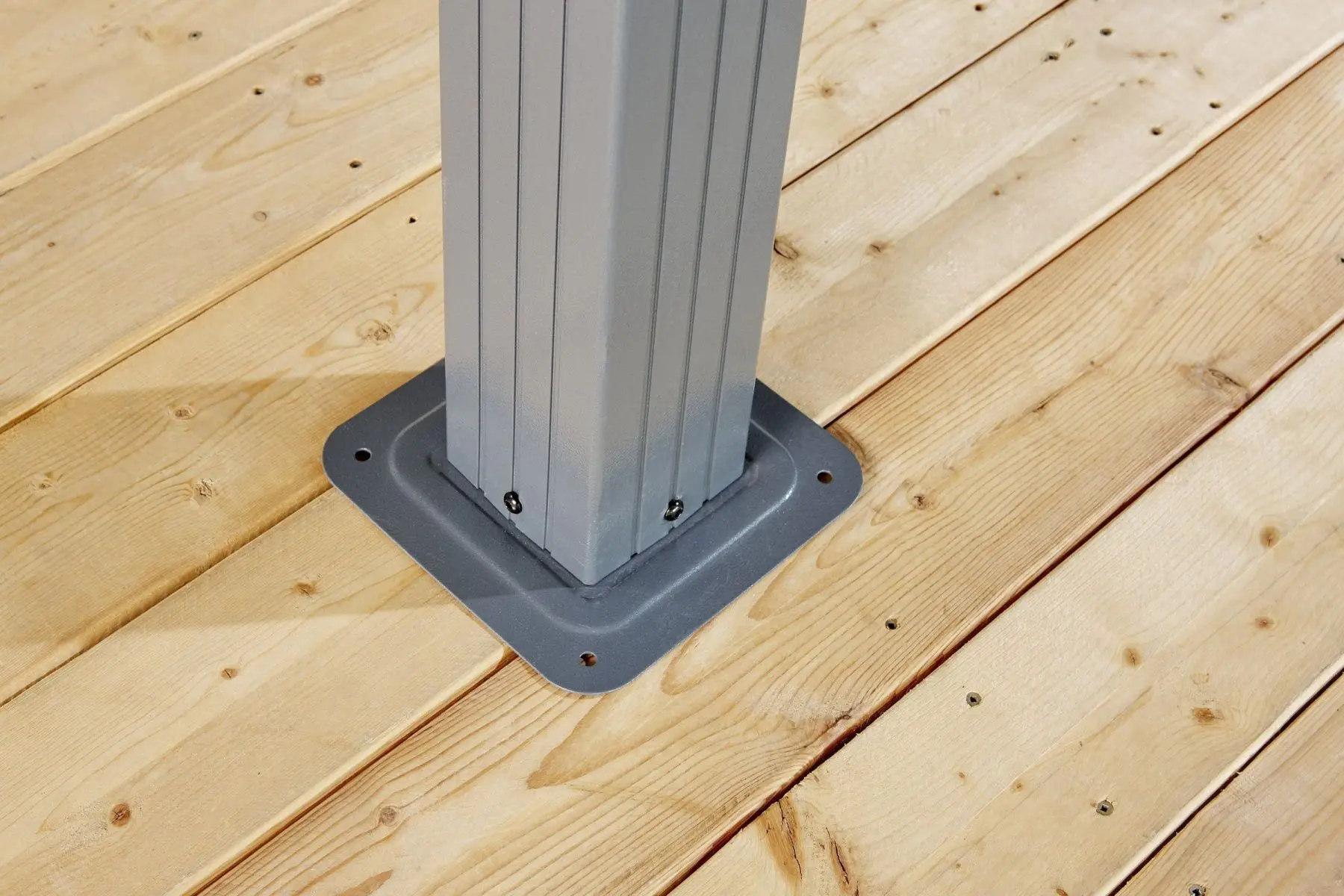
All three lines ship LTL, which in practice means a freight truck and a curbside drop, not a courier walking boxes to your deck. Budget for three to five cartons, two people and a hand truck on delivery day, and clear a path before the truck arrives — a 10 × 20 ft kit is not something to improvise in a driveway in November. The Hilo column bases come pre-drilled, so anchoring to a slab, a deck frame or a footing is a matter of the right fasteners for the surface rather than drilling the posts yourself. Sojag lists a one-year limited warranty on the Hilo; warranty terms differ by brand, so read the product page for the model you pick.
What fits under 10 × 10, 10 × 12 and 10 × 20
This is where most people get the size wrong, because the posts stand inside the stated footprint. Measuring the catalogue's interior dimensions gives you the honest number: the 10 × 10 ft Hilo covers about 8 ft 11 in square, or 79 sq ft; the 10 × 12 ft covers about 11 ft by 8 ft 11 in, close to 99 sq ft; and the 10 × 20 ft covers roughly 18 ft 4 in by 8 ft 11 in, about 163 sq ft. Clear height under the beam is 84 in — 7 ft — on all three, with the frame itself standing 88.9 in tall.
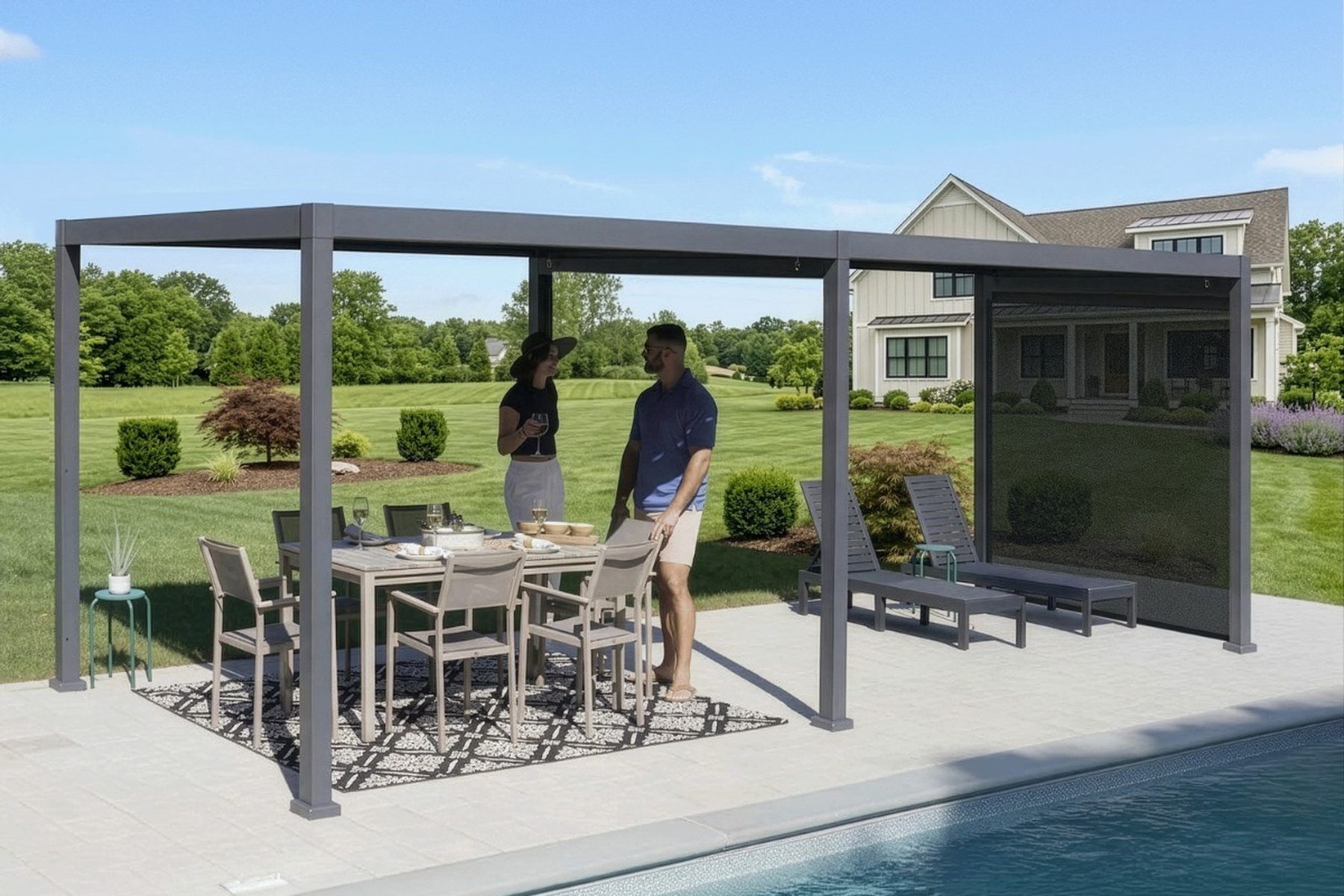
In furniture terms: a 10 × 10 ft model fits a round table with four to six chairs, or a small lounge set, with just enough room to push a chair back. A 10 × 12 ft model is the comfortable size for a rectangular six-seat table. A 10 × 20 ft model is really two rooms under one roof — dining at one end, lounge chairs or a hot tub at the other — and it is the one to measure twice, because it needs a run of flat ground almost 20 ft long. For the pad itself, Sojag lists a 123 × 123 in foundation footprint for the 10 × 10 ft Hilo, a couple of inches wider than the frame on every side, so size a slab or deck to that rather than to a bare 10 ft.
Winter in Canada: what a louvered pergola can and cannot do
A louvered pergola is designed to stay up all year. There is no fabric to remove and nothing to fold, and powder-coated aluminum does not rust through a Quebec freeze-thaw cycle the way untreated steel would. That is a real advantage over a canopy pergola, which has to come down every October.
Products in this guide

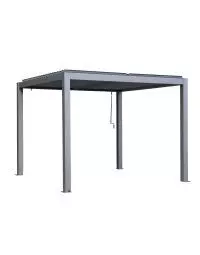
What it is not is a snow roof. Unlike our carports and garages, which carry published snow-load ratings, the pergolas in our catalogue carry no snow-load figure at all — they are shade structures with a rain-shedding roof, not winter buildings. The practical advice we give customers: crank the blades open before the first real storm so snow falls through the roof instead of piling on a closed deck of blades, clear what accumulates on the beams after a heavy wet snowfall, and do not count on the gutter system once everything in it is frozen. If you want a structure that holds snow and keeps a car or a lounge area usable in February, that is a carport or a solarium question, not a pergola question.
Sides, screens and privacy
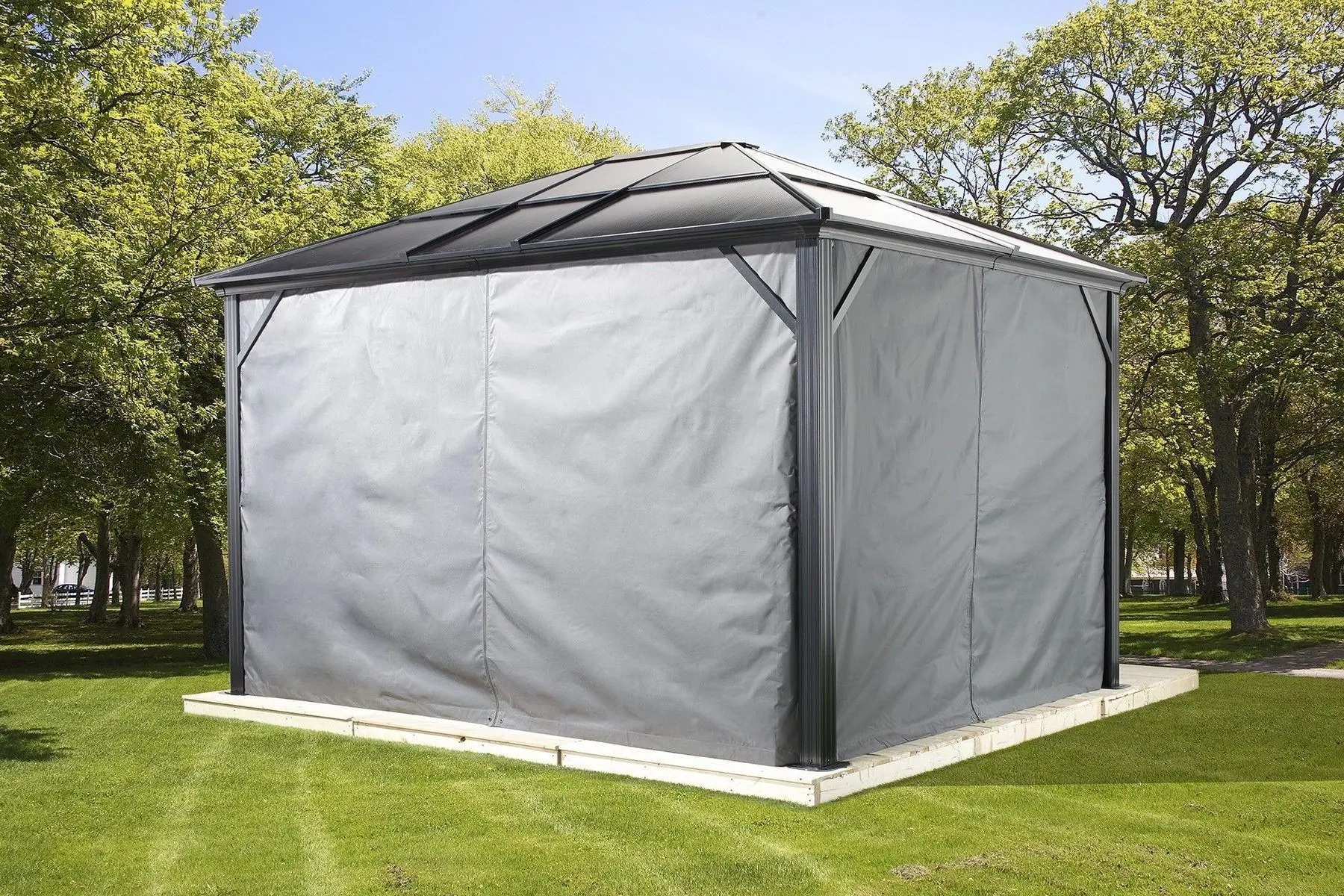
A roof alone rarely finishes the job. Low evening sun comes in sideways, a neighbour's window looks straight onto the deck, and the mosquitoes arrive at exactly the hour you wanted to eat outside. All three of our louvered lines take add-ons for this. Sojag sells a glass-fibre privacy panel that mounts to the Hilo frame with pre-drilled holes and pulls down to the height you want, in a 12 ft size for the longer runs. Gazebo Penguin offers the Vikos with curtain tracks built into the frame, plus black mosquito netting sized for the 10 × 10 and 10 × 13 models, which ships as a parcel rather than freight. Corriveau sells black manual textilene side panels for the Casilda and the Glendale — up to four per pergola, in a 10 ft and a 13 ft width to match the side you are closing in.
Plan these at the same time as the pergola, not a season later. The anchor points and tracks are part of the frame, and it is far easier to order the pergola accessories with the structure than to retrofit a screen to a roof that is already standing. If you are weighing a fully closed structure instead, a gazebo with curtains or a solarium is a different conversation with a different budget.
Frequently asked questions
Can a louvered pergola stay up all winter in Canada?
Yes. The aluminum frames we sell are powder-coated and rustproof, and there is no fabric to remove, so the structure stays up year-round. Because no snow-load rating is published for these models, open the blades before heavy snow so it falls through, and clear what builds up on the beams.
Is a louvered pergola waterproof?
No. With the blades closed, rain runs off into the gutter integrated in the beam and drains through a post, which is enough to keep a table dry in a passing shower. None of the Sojag Hilo, the Gazebo Penguin Vikos or the Corriveau louvered pergolas is listed as waterproof, so expect some drips at the seams in a long downpour.
Do the louvers need electricity or a motor?
No. All three lines are hand-cranked, with no motor and no wiring. The Sojag Hilo and the Gazebo Penguin Vikos ship two cranks, one per roof section, and the Corriveau Casilda has its blades split into two banks in the same way; the Glendale's blades run the full length of the roof and turn as one. Either way there is no electrician and nothing to fail during a power cut.
What size do I need for a six-seat dining table?
A 10 × 12 ft model is the comfortable choice: it covers about 11 ft by 8 ft 11 in between the posts, which leaves room to pull the chairs out. A 10 × 10 ft works for a round table with four to six chairs; go to 10 × 20 ft when you want dining and lounging under the same roof.
The bottom line
If you want a backyard you can use on a hot afternoon and still use when the sky turns, a louvered pergola earns its place. Pick the size from the covered area between the posts rather than the name on the carton, decide early whether you want privacy screens or mosquito netting, and prepare a pad that is a few inches larger than the frame. Browse our pergolas and pergola accessories to compare the Sojag Hilo, the Gazebo Penguin Vikos and the Corriveau Casilda and Glendale side by side, or read our guide to choosing between a gazebo and a pergola if you are still deciding what kind of structure your yard needs.
Reviewed by the IPATIO team, Saint-Laurent, Quebec.