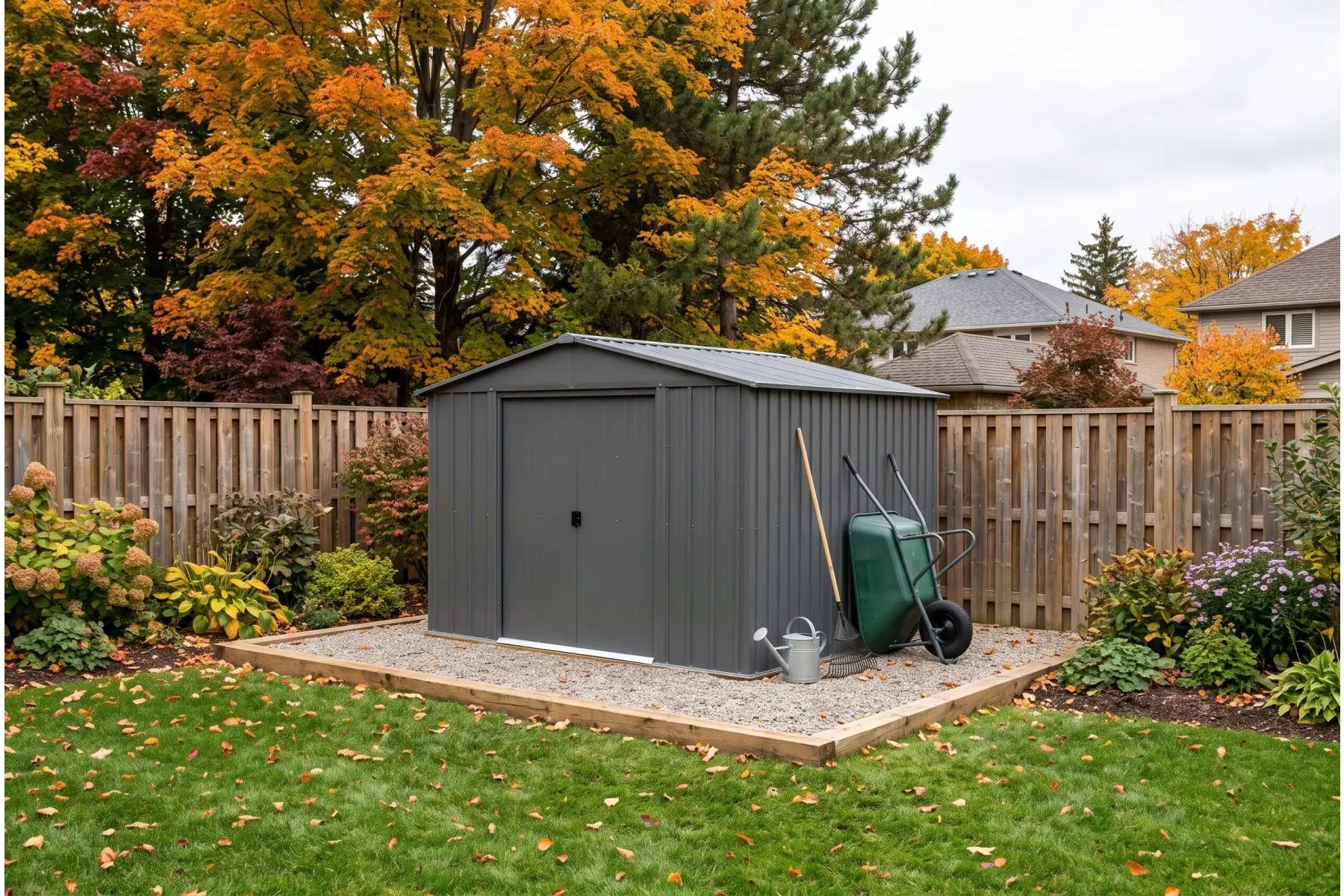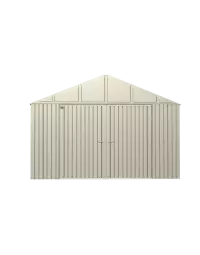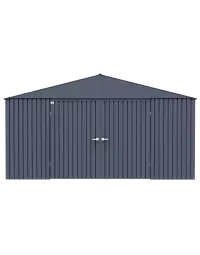
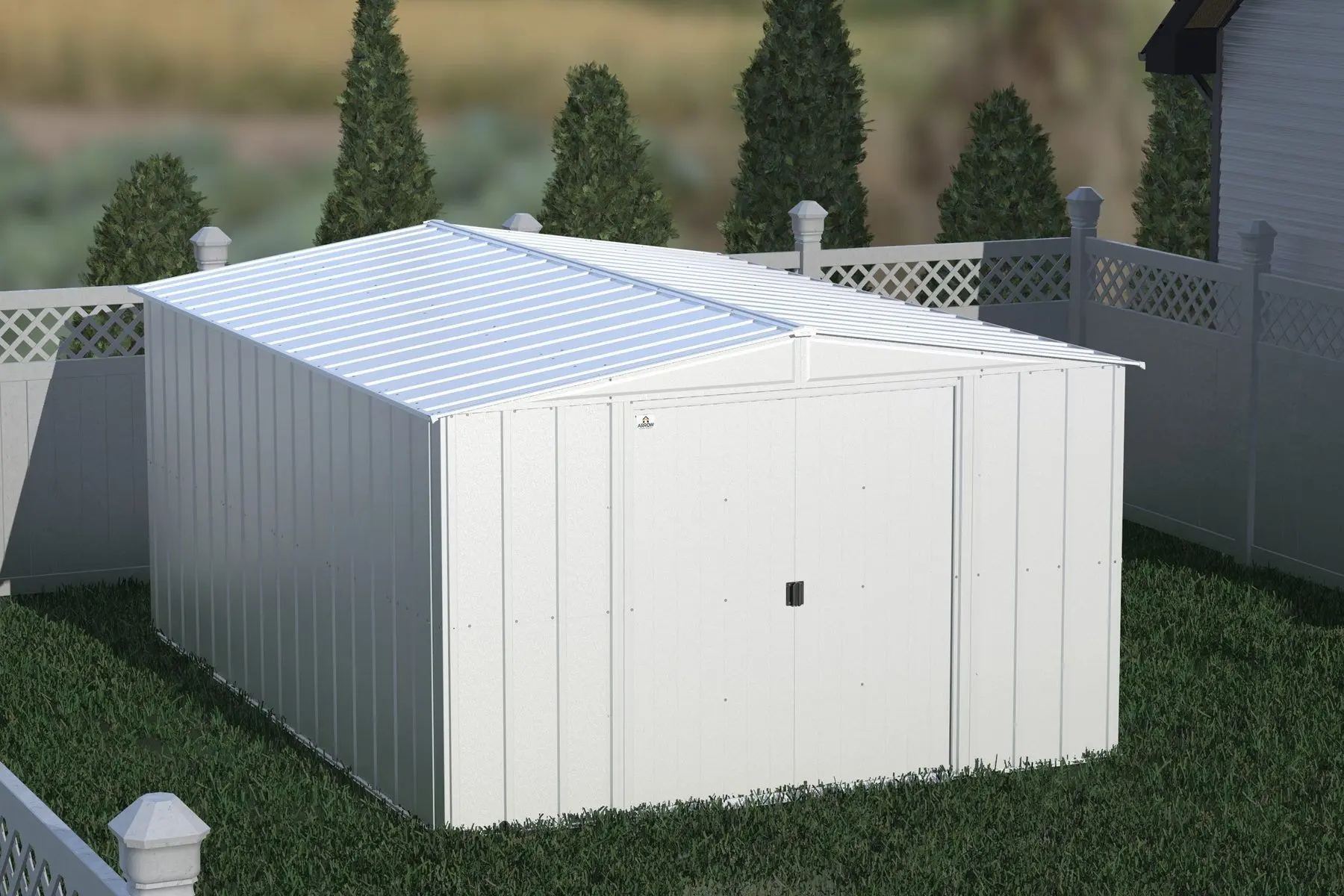
Most backyard storage guides stop at 10x12. In Canada that is often where the real problem starts: the mower, the snowblower, four patio chairs, the barbecue, the bikes and a workbench do not share 115 square feet politely. The next step up — a 12x14, a 12x17, a 14x14 or a 14x17 steel building — is not simply "the same shed, bigger". Above 10 feet wide the whole platform changes: the doors get wider but not taller, the roof gets a different gable, the base stops being optional, and the shipment travels by freight carrier instead of parcel courier.
This guide compares the large metal sheds we sell in Canada by the numbers that actually decide the purchase — usable floor area, interior height, door opening, pad footprint and delivery weight — so you can choose a size once and not discover the mistake in February. Every figure below comes from the product specifications in our own catalogue.
Where "large" starts, and what changes above 10 feet
Arrow's steel buildings come in three widths that behave quite differently. The 10-foot-wide Classic models (10x12, 10x14) are the top of the compact range: one shipping carton, a low gable and a modest 74.6 in interior peak height. Step to a 12-foot-wide Classic and the building grows upward as well as outward — the interior peak reaches 93.25 in and the gable is 28 in deep. Step again to a 14-foot-wide Classic and the floor grows but the roof flattens: interior peak 86.31 in, gable 20.5 in.
That is the first non-obvious result of this comparison: a Classic 12x12 is taller inside than a Classic 14x14, even though the 14x14 holds 55 more square feet of floor. If you plan to stand a ladder upright, hang long tools on the gable wall or stack shelving to the roof line, the 12-foot-wide buildings give you the most vertical room in the Classic line. If you need floor, go wide.
What actually fits: floor area and volume by size
Floor area tells you what you can park; volume tells you what you can stack. Both are listed per model, and the gap between them is where planning goes wrong — two buildings with nearly identical floor area can differ by hundreds of cubic feet once the roof shape is taken into account.
| Model | Floor area | Storage volume | Interior peak | Pad footprint |
|---|---|---|---|---|
| Arrow Classic 10x12 | 115 sq ft | 674 cu ft | 74.6 in | 10.1 x 11.9 ft |
| Arrow Classic 10x14 | 129 sq ft | 755 cu ft | 74.6 in | 10.1 x 13.4 ft |
| Arrow Classic 12x12 | 138 sq ft | 913 cu ft | 93.3 in | 12.0 x 11.9 ft |
| Arrow Classic 12x14 | 166 sq ft | 1,100 cu ft | 93.3 in | 12.0 x 14.3 ft |
| Arrow Classic 12x17 | 194 sq ft | 1,287 cu ft | 93.3 in | 12.0 x 16.7 ft |
| Arrow Classic 14x14 | 193 sq ft | 1,218 cu ft | 86.3 in | 13.9 x 14.3 ft |
| Arrow Classic 14x17 | 226 sq ft | 1,425 cu ft | 86.3 in | 13.9 x 16.7 ft |
| Arrow Elite 12x14 | 164 sq ft | 1,186 cu ft | 100.4 in | 12.1 x 14.1 ft |
| Arrow Elite 14x16 | 220 sq ft | 1,518 cu ft | 93.2 in | 14.1 x 16.1 ft |
Read the last two rows against the Classic ones. The Elite 14x16 has slightly less floor than the Classic 14x17 but almost 100 cubic feet more space, because its walls stand taller before the roof starts. If your storage problem is "too much stuff" rather than "too many machines", height is worth more than length.
A practical way to use the table: draw your largest machine on the floor plan first, then an aisle beside it wide enough to walk with both arms full, then shelving on the remaining wall. A 12x17 gives you a 16-foot run along one wall — long enough for a workbench and a tire rack behind a parked machine — while a 14x14 gives you a squarer room that suits two machines side by side.
The doorway is the real limit
This is the specification most buyers never check, and it is the one that cannot be changed after assembly. Across the entire Arrow Classic range — from the 10-foot models up to the 14x17 — the door opening is 63 in high. It does not grow with the building. What grows is the width: 55.5 in on the 10-foot-wide models, 67.9 in on the 12-foot-wide ones, 77.1 in on the 14-foot-wide ones.
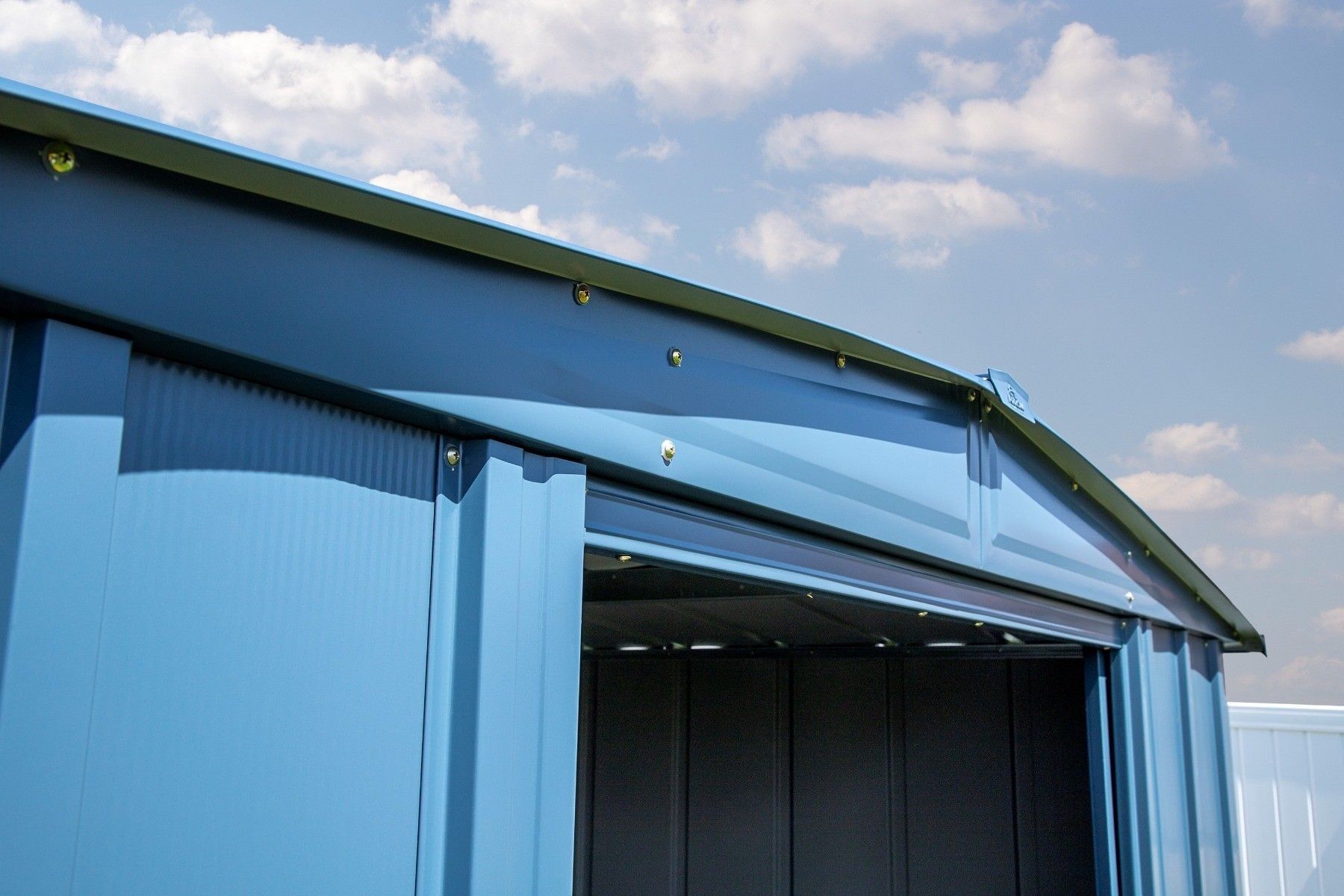
The Elite series answers this differently. Its reinforced swing doors open 69.8 in high, and on the 12- and 14-foot-wide buildings the opening is a full 88 in wide. That is the widest doorway in the range and the reason people with a lawn tractor, a side-by-side or a utility trailer end up in the Elite line rather than the Classic one. The Select series sits between the two with a 69 in high, 59.3 in wide opening on its 10-foot-wide models.
Door style matters as much as size in winter. Sliding doors run on an overhead track and never swing into a snowbank, but they need the full width of the gable wall clear. Swing doors give you the whole opening at once, which is what you want when carrying something awkward, but you have to shovel a clear arc in front of them.
Classic, Select, Elite, Woodridge or Ironwood
All five are steel, all five are sold as kits, and none of them includes a floor. The differences are in the steel, the finish, the vents and the warranty.
| Series | Doors | Panels and finish | Notable feature | Warranty |
|---|---|---|---|---|
| Classic | Sliding, padlockable | Vertical panels, galvanized steel with Sherwin-Williams polyester paint | Low gable pitch that keeps water from pooling | 12 years |
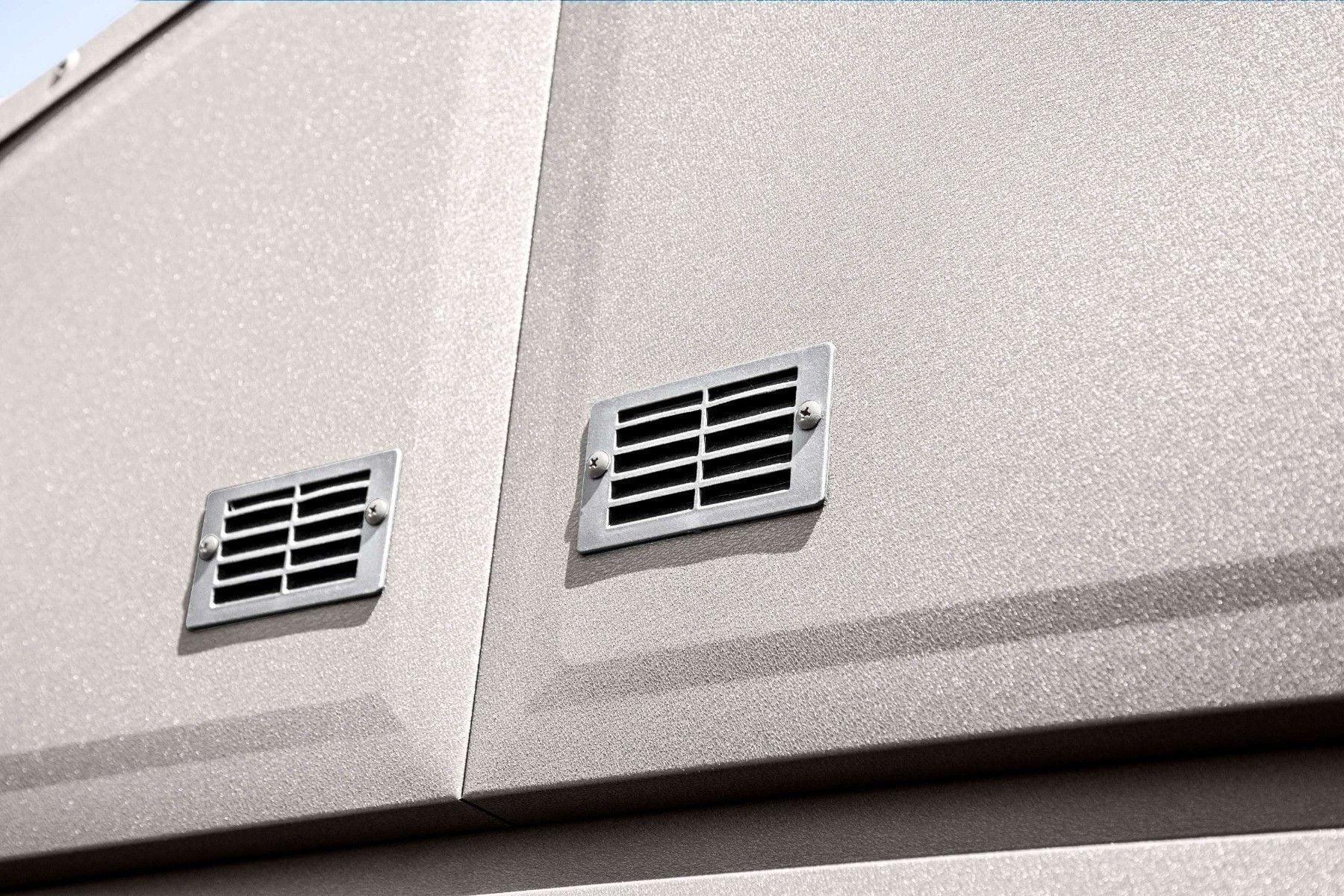
| Select | Swing, locking handles | Horizontal siding, galvanized steel with Sherwin-Williams paint | High gable and built-in air vents | 12 years |
| Elite | Reinforced swing, keyed handle | Squared panels, Galvalume steel with wrinkle-textured paint | 72 in walls and gable vents | 15 years |
| Woodridge | Sliding, padlockable | Horizontal woodgrain siding, zinc-treated steel | Wood look without wood maintenance | 12 years |
| Ironwood | Sliding, lockable | Steel frame, roof and door; wood panels supplied by you | Paint or stain it to match the house | 12 years |
The Elite is the only series in this group plated with Galvalume — aluminium, zinc and silicon — rather than plain galvanizing, and the only one carrying a 15-year warranty. The Ironwood is a different proposition altogether: it is a steel skeleton with the wood panelling deliberately left out, so you choose the cladding, run it vertically or horizontally and finish it yourself. Budget for the lumber and the stain before you compare its price with a finished building.
One thing no steel building in this class is: waterproof. They are weather-resistant shells, not sealed rooms. Cardboard boxes belong on a shelf or a pallet, not on the base, and anything that rusts should sit off the floor.
The base, the anchors and the snow
None of these kits ships with a floor, so the base is your decision and it has to be built before the delivery arrives. Note that the pad is slightly smaller than the building: the Classic 14x17 stands 169 x 203.25 in overall but its foundation rectangle is 166.75 x 200.75 in, because the roof overhangs the walls. Build to the foundation dimension, not the exterior one, and keep the pad dead level — a 16-foot wall shows every millimetre of twist in the door track.
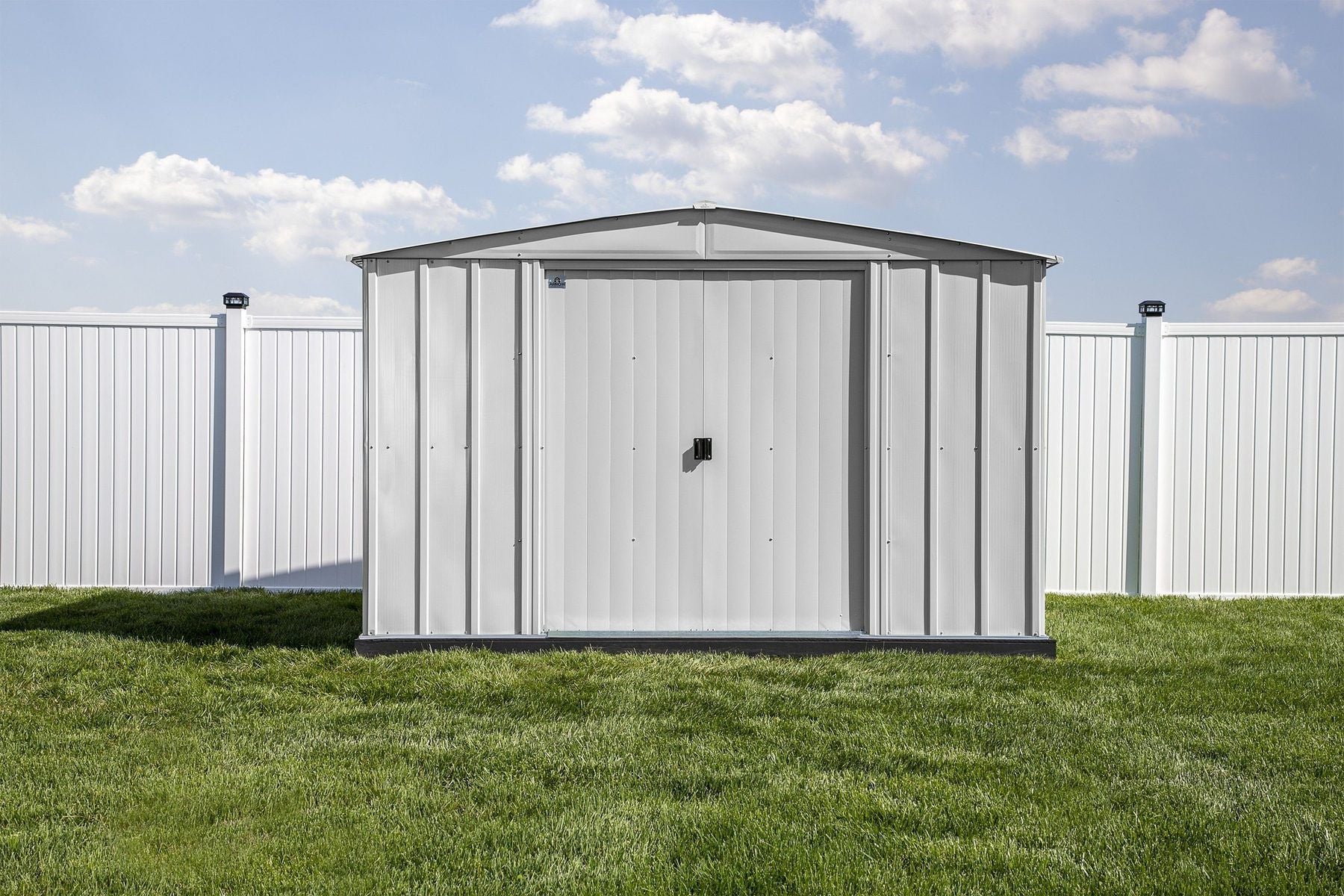
Floor frame kits are available for the smaller end of this range only: the Classic and Select 10x11, 10x12 and 10x14, and the Classic 12x12. Above that there is no frame kit to buy, which in practice means a concrete slab or a properly built wood platform for any 12- or 14-foot-wide building. Treat that as part of the project cost, not an afterthought.
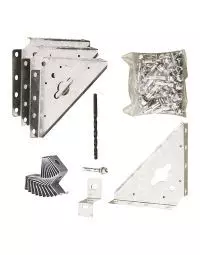
Anchoring is not optional in a Canadian winter — an empty steel building is a sail. The Arrow Concrete Anchor Kit bolts the base rail to a slab with four corner gussets, perimeter clips and lag bolts, and its clips can be repeated every 2 feet, which is exactly what a long building needs. On ground, the ground auger kit twists galvanized augers into the soil and tethers the frame with steel cables, no concrete required. Watch the fine print on the small earth anchor kit: it is designed for buildings no larger than 10 x 10 ft and is the wrong product for anything in this guide.
Snow is the other half of that conversation. Roof strengthening kits are made for the 10x12 and the 10x13/10x14 buildings (except swing-door models) and must go in during assembly — retrofitting one means taking the roof apart. There is no equivalent kit for the 12- and 14-foot-wide models, so on those the roof is what it is: keep it clear after heavy, wet storms, and never pile shovelled snow against the walls, where it both loads the panels and holds moisture against the steel all winter.
Delivery day, assembly and permits
Every building in this guide ships by freight carrier: most carriers deliver to the curb by default and, when they offer that service, contact you to book a delivery appointment. On arrival, refuse damaged boxes when possible, or note the damage on the delivery slip. Plan the move to the back yard yourself, and note that the cartons are long: the Classic 12x17 arrives as two cartons with the largest around 81 in long and 34 in wide, the Classic 14x17 as two cartons around 92 in long, and the Elite 12x14 and 14x16 as three cartons weighing roughly 635 lb and 715 lb in total. Before you order, walk the route from the curb to the pad and look for the gate, the step and the soft lawn.
Products in this guide
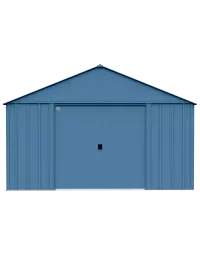
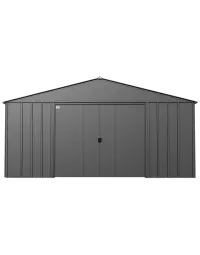
These are assembly-required kits with pre-drilled parts, and at this size they are genuinely a two-person job: panels this long are awkward in any wind, and the roof goes together overhead. Pick a calm, dry weekend, lay the parts out by step before you start, and leave the doors for last — they are the part that has to be adjusted square.
Finally, check your municipality before you buy. Many Canadian cities require a permit for accessory buildings above a given floor area and impose setbacks from property lines and easements — thresholds that a 12x17 or 14x17 can cross even where a 10x12 would not. A ten-minute phone call beats moving a building that is already bolted to a slab.
Frequently Asked Questions
Will a riding mower fit through the door of a large metal shed?
Measure the machine first, including the seat back and the deck. The Arrow Classic doorway is 63 in high at every size, with widths of 55.5 in (10 ft wide models), 67.9 in (12 ft) and 77.1 in (14 ft). The Arrow Elite 12x14 and 14x16 open 88 in wide and 69.8 in high, which is the most generous opening in the range and the usual answer for a lawn tractor with a bagger or a side-by-side.
Do I need a concrete slab for a 12x17 or 14x17 shed?
You need a level, load-bearing base of some kind, and at this size the realistic options are a concrete slab or a built wood platform. Floor frame kits exist for the Classic and Select 10x11 to 10x14 and the Classic 12x12 only, so there is no bolt-on frame for the larger footprints. Whatever you build, match the foundation dimensions listed for your model rather than the exterior dimensions, since the roof overhangs the walls.
Is a 12-foot-wide shed taller inside than a 14-foot-wide one?
In the Classic line, yes. The 12-foot-wide buildings have a 28 in gable and a 93.3 in interior peak, while the 14-foot-wide buildings have a 20.5 in gable and an 86.3 in peak. The 14-foot models give you more floor, the 12-foot models more height. The Elite 12x14 is taller still at 100.4 in.
How is a large steel shed delivered in Canada?
By freight carrier; most carriers deliver to the curb by default. Expect two cartons for a large Classic and three for an Elite, with the longest carton around 92 in and total weights in the 500 to 700 lb range. Plan for two people and a flat route to the pad on delivery day, and make sure the base is finished and cured before the truck arrives.
Choosing your size
If you are replacing a full 10x12, the honest upgrade is usually one size wider rather than one size longer: the 12-foot-wide Classic buildings add height and a wider doorway at the same time, and the 12x17 adds a genuinely useful 16-foot wall. If machines are the problem, go to the Elite 12x14 or Elite 14x16 for the 88 in doorway. If the yard is the constraint, measure the pad footprint in the table against your setbacks before you fall in love with a floor plan.
Whichever size you land on, budget the base, the anchor kit and a free weekend along with the building itself. Browse the full range of sheds and the shed accessories that go with them, and if you are between two sizes, take the larger one — nobody has ever complained about the extra 30 square feet in January.
Reviewed by the IPATIO team, Saint-Laurent, Quebec.