
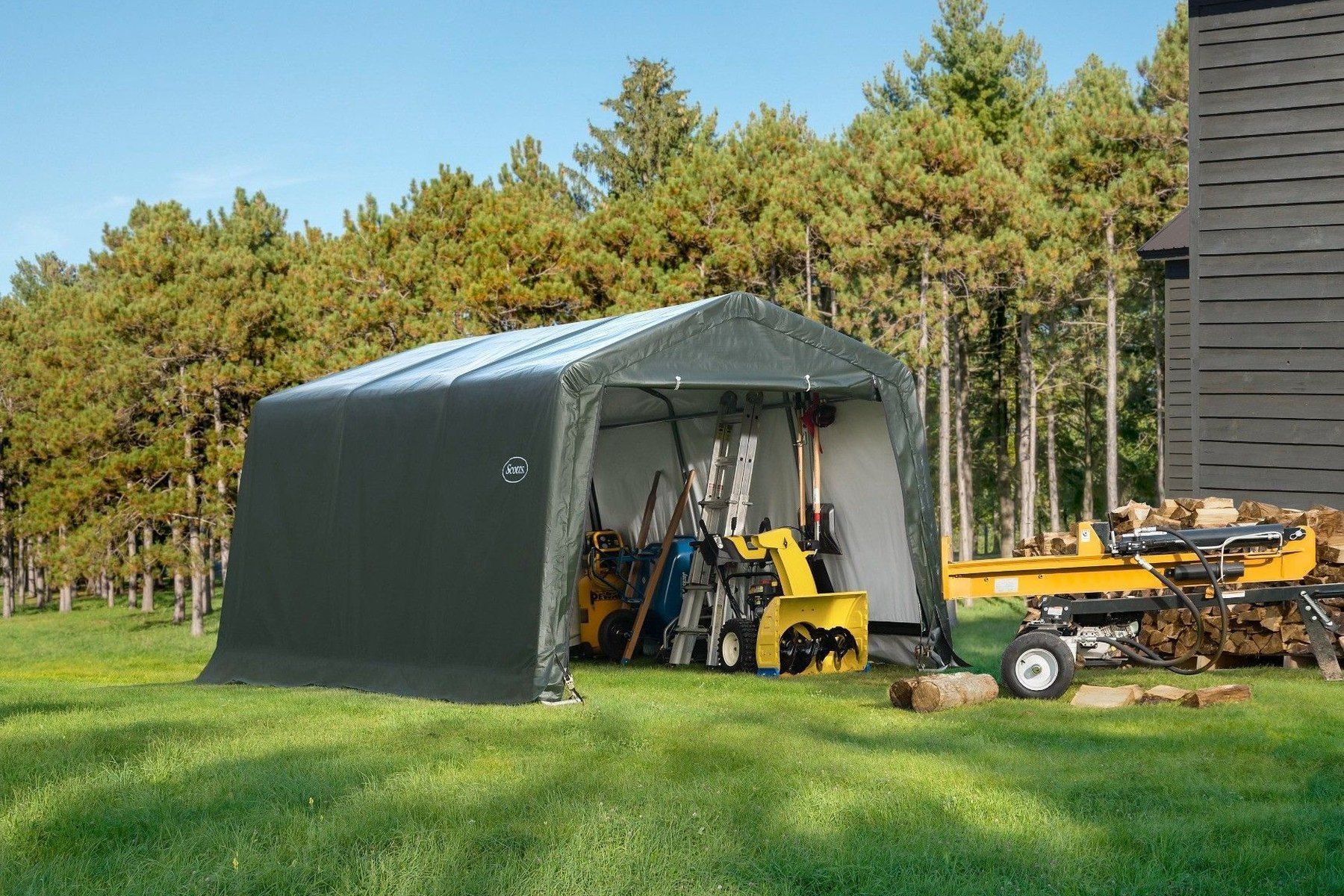
A portable storage shed is the cheapest covered square footage you can add to a Canadian backyard. No concrete, no permanent footprint, and in most municipalities no building permit — just a powder-coated steel frame, a fitted cover and somewhere between 35 and 146 square feet of space for the mower, the patio furniture and the snowblower you need to reach in January.
The catch is that "portable" and "Canadian winter" pull in opposite directions, and the one spec that decides how well they get along is printed on the listing without ever being explained. This guide covers what is actually in the box, how to read the capacity numbers, and why the shape of the roof matters more than the brand badge once the snow starts in November.
The short answer
If the shed comes down before the heavy snow, or stands where winters are light, a peak-roof fabric shed is the value pick: the ShelterLogic Shed-in-a-Box Peak Storage Shed 10 × 10 × 8 ft gives you 97.59 sq ft of floor and 621 cu ft of volume in a single 89 lb carton. If the same structure has to stand loaded through a Quebec, Ontario or Prairie winter, move to the curved roof instead. The ShelterLogic Shed-in-a-Box Round Top Storage Shed 10 × 10 × 8 ft is rated to 20 psf of snow and 50 mph of wind, against 8 psf and 30 mph for the peak model — two and a half times the snow rating on the same footprint, for about 15 lb more steel and fabric. And if what you want is an ATV or a motorcycle kept out of the weather rather than shut in a room, an open-sided metal shelter such as the Arrow Metal Canopy 10 × 6 × 7 ft is rated to 35 psf and 100 mph and carries a 10-year limited warranty.
What you actually get in the box
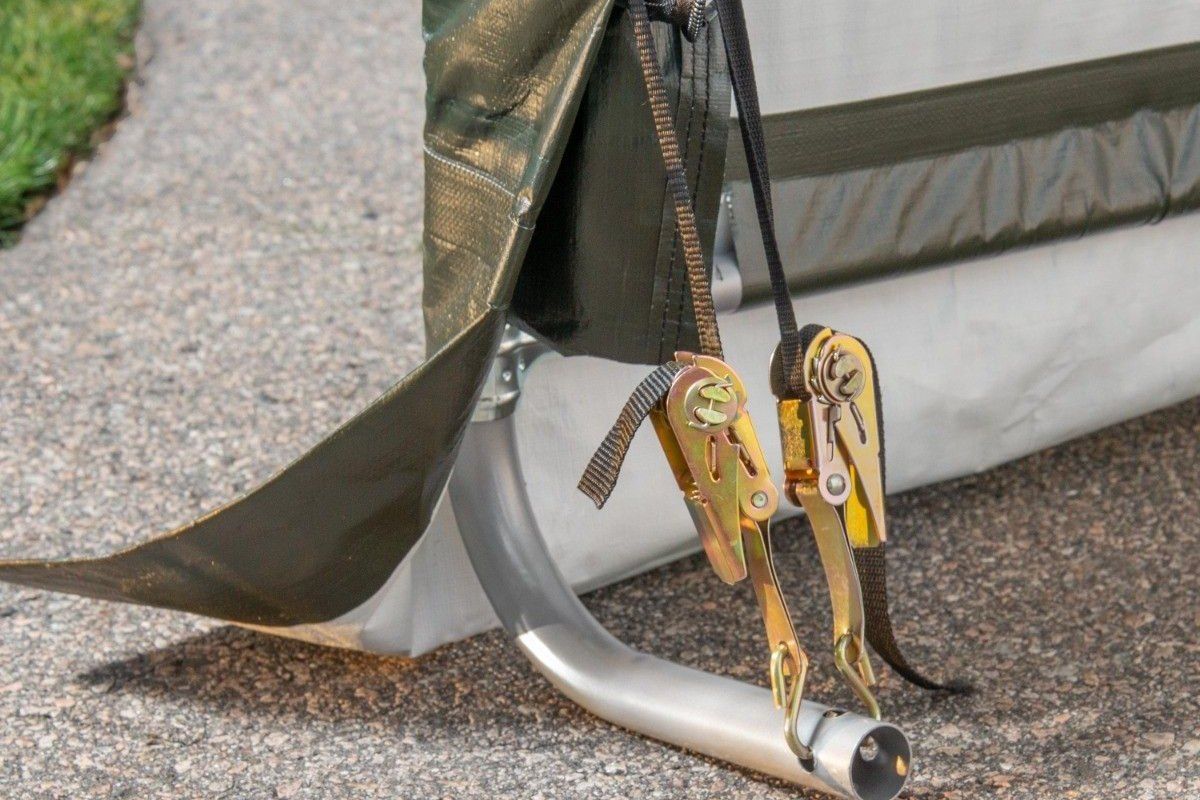
Every fabric storage shed we carry is built the same way: a 1-3/8 in. all-steel frame with a thermoset powder-coated finish, wrapped in a triple-layer ripstop polyethylene cover that is waterproof and UV-treated on both faces. The cover is pulled tight with a ratchet-and-strap tensioning system rather than bungees, which is what keeps it from flapping itself to death in a February wind. The front is a double-zippered door panel; the back is a solid panel. Four 15 in. auger anchors are in the carton.
Two things are not in the carton, and both surprise people. There is no floor — the shelter stands on whatever ground you prepare. And the warranty is one year limited, which is the honest signal that these are relocatable storage, not a building. The steel is the part that lasts; the cover is a wear item measured in seasons of sun, not decades.
Worth knowing if two listings look almost identical: the Scotts and ShelterLogic fabric sheds are the same engineering under different colours. At 10 × 10 ft the Scotts measures 97.67 sq ft against the ShelterLogic's 97.59, and ships at 89 lb against 89.3. Choose on colour and size, not on the badge.
Sizing: match the volume, not just the footprint
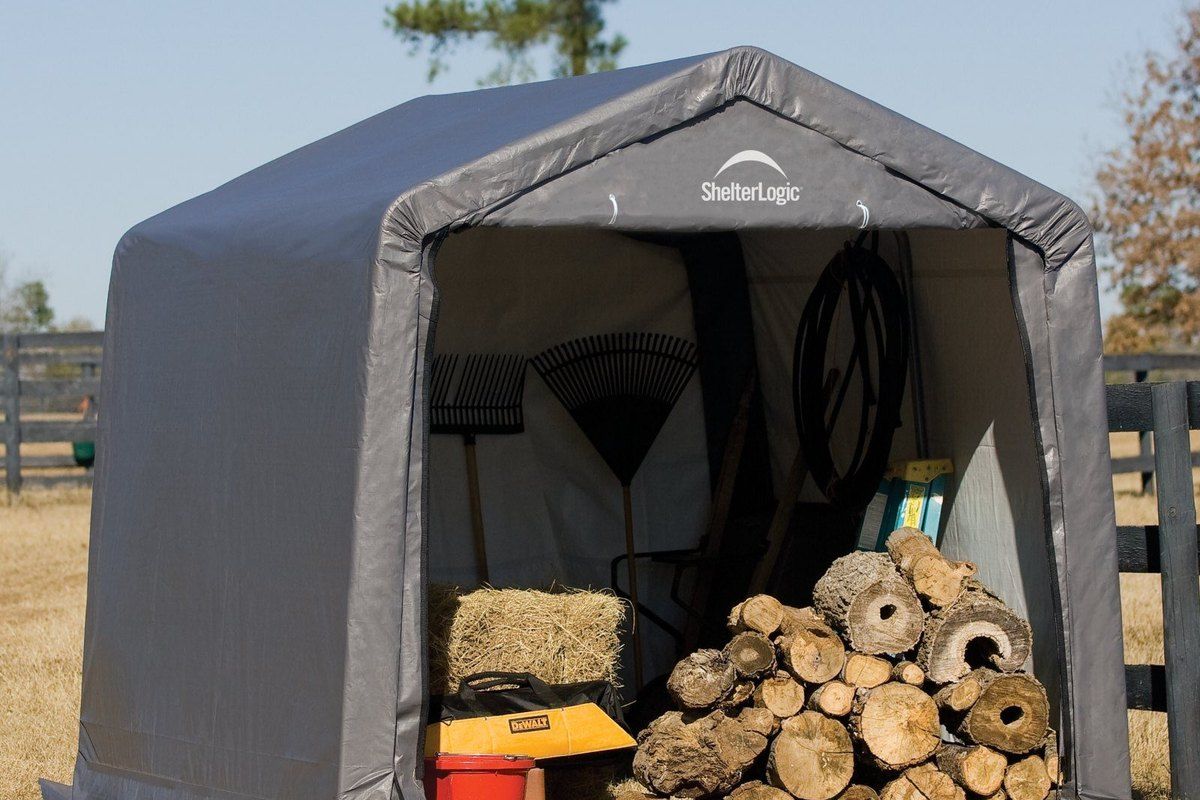
Floor area is the number everyone shops on and the number that misleads most. A fabric shed with a peak roof has usable height almost all the way to the walls, so the cubic volume is what tells you whether the ladder, the wheelbarrow and the stacked deck chairs will all go in. Here is what the range actually measures.
| Model | Floor area | Volume | Interior height | Shipping weight | Snow / wind rating |
|---|---|---|---|---|---|
| ShelterLogic Shed-in-a-Box Peak Storage Shed 6 × 6 × 6 ft | 35.6 sq ft | 176 cu ft | 71.0 in | 50.8 lb | Not published |
| ShelterLogic Shed-in-a-Box Peak Storage Shed 8 × 8 × 8 ft | 64.0 sq ft | 395 cu ft | 94.9 in | 79.8 lb | Not published |
| ShelterLogic Shed-in-a-Box Peak Storage Shed 10 × 10 × 8 ft | 97.6 sq ft | 621 cu ft | 96.9 in | 89.3 lb | 8 psf / 30 mph |
| ShelterLogic Shed-in-a-Box Round Top Storage Shed 10 × 10 × 8 ft | 100.6 sq ft | 603 cu ft | 94.5 in | 104.7 lb | 20 psf / 50 mph |
| Scotts Peak Storage Shed 10 × 15 × 8 ft | 145.9 sq ft | 929 cu ft | 98.1 in | 110 lb | 8 psf / 30 mph |
Read the table from the right-hand columns. The 6 × 6 ft size is a tool locker: trimmer, rakes, a bag of fertilizer, the cushions. At 8 × 8 ft you can walk in and turn around with a wheelbarrow. The 10 × 10 ft sizes swallow a riding mower or a snowblower plus the summer furniture, and the 10 × 15 ft is where a quad, a pair of mowers and the firewood all fit at once. The smaller sizes carry no published snow or wind rating — treat them as fair-weather lockers you empty or clear after storms, not as winter structures.
Delivery is the other practical number. These ship as one carton — the 10 × 10 ft box is about 44 × 21 × 8 in. and 89 lb — so a courier leaves a single long, heavy package at the end of the driveway. Plan two people for the day it arrives, not for assembly day.
Peak or round top? The roof decides your winter
This is the part that is almost never spelled out. Across the 10 × 10 ft size, where both profiles are published, the peak roof is rated to 8 psf of snow and 30 mph of wind; the round top is rated to 20 psf and 50 mph. Same brand, same footprint, same frame diameter — the curve is what carries the load, because snow slides off a continuous arc instead of settling into the valley a gable creates.
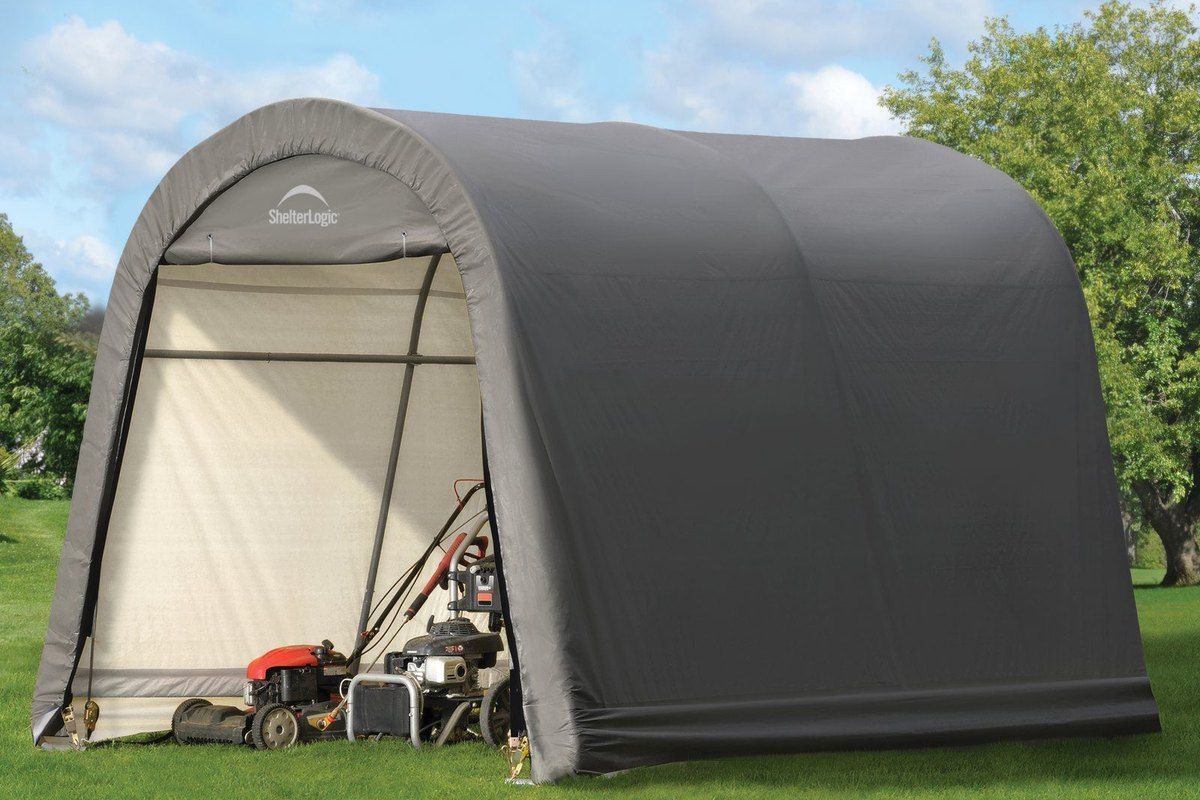
Put those ratings in context before you buy. Eight pounds per square foot is roughly a foot and a half of fresh, dry snow — but only a few inches of the same snow after it has thawed, refrozen and packed, which is exactly what happens on a Montreal or Ottawa roof between December and March. Twenty psf gives you real margin; eight does not. Neither number is a licence to stop looking at the thing all winter, and manufacturers state these ratings for a properly anchored, standalone structure with nothing leaning on it.
So: if the shelter is going up in April and coming down in October, the peak roof is the better buy and the better headroom. If it stays up year-round anywhere east of the Rockies, pay for the curve. If you want to understand the psf figure itself — how it is measured and what Canadian ground loads look like — our guide to snow load ratings goes through it properly.
Siting, anchoring and winter care
Ground first
Because there is no floor, the ground is the floor. Level, well-drained and slightly proud of the surrounding grade is the goal; a compacted gravel pad is better again, because it keeps the cover's bottom hem out of standing water and stops the frame from settling unevenly over a season. Avoid the low corner of the yard where meltwater collects, and leave a couple of feet clear on every side so you can brush snow off without climbing.
Anchor it properly, and anchor it now
The four auger anchors in the box are the minimum, and they want soil they can bite into. This is the argument for setting one of these up in October rather than December: once the first few inches of ground are frozen, an auger anchor will not go in, and a tarp-covered steel frame with no anchors is a sail. On a deck, a patio or a gravel pad, the auger anchors are the wrong tool entirely — use the appropriate shed accessories for a hard surface instead.
Through the winter
Three habits keep a fabric shelter alive. Brush the roof after any significant snowfall, with a soft broom from the outside and never by pushing up from inside. Re-tension the cover a couple of times a season, since a cover that has gone slack is the one that collects water, freezes and tears. And leave the door partly unzipped on mild days — the whole structure is a vapour barrier, so condensation will find anything that rusts. Mowers, bikes, patio furniture and firewood are fine. Paper, fabric, electronics, fuel and anything that must stay bone dry are not.
When a metal shelter is the better buy
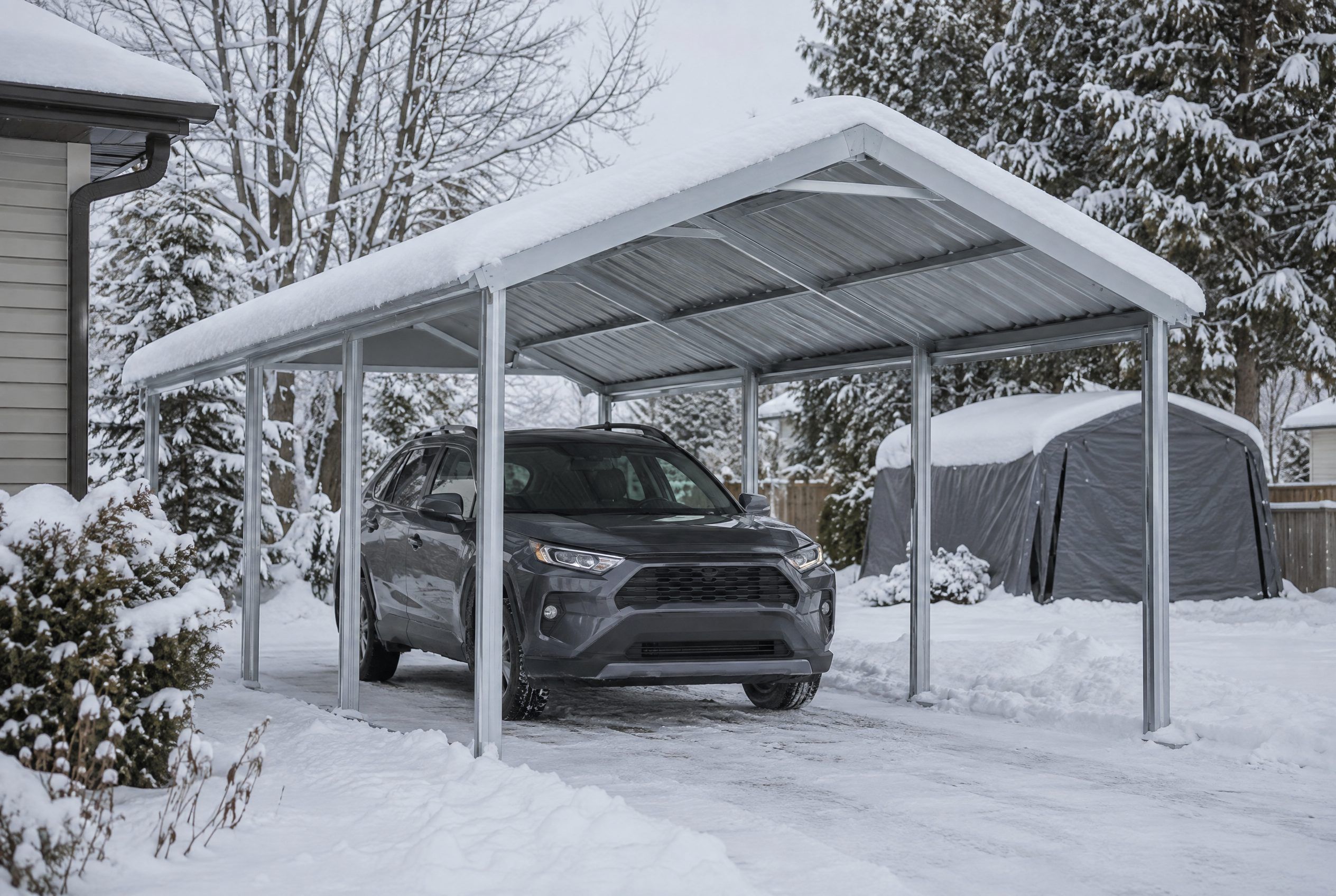
A fabric shed is the right answer for most backyards, but not all of them. If you are covering a motorcycle, an ATV, a grill or a smoker — something you want kept dry and ventilated rather than locked away — an open-sided metal shelter does it better. The Arrow Metal Canopy 10 × 6 × 7 ft puts a 29-gauge galvanized steel roof on a powder-coated steel frame, rated to 35 psf of snow and 100 mph of wind, with a 10-year limited warranty instead of one. It gives up the closed walls and arrives as two cartons totalling about 243 lb.
Products in this guide


And if what you really want is a permanent building with a lockable steel door and a floor frame, that is a steel shed, not a shelter — a different budget and a different foundation. Our large metal shed guide and our shed foundation guide cover that decision.
Frequently Asked Questions
Do I need a building permit for a portable storage shed in Canada?
In most cases no, because there is no permanent foundation and the structure is relocatable — which is a large part of why people choose one. Municipal rules vary a great deal across Quebec, Ontario and the Prairies, and some cities regulate any accessory structure over a certain floor area or set back from the property line regardless of foundation. Check with your municipality before you order, especially above 100 sq ft.
Can I leave a fabric storage shed up all winter?
Yes, if you choose the right roof and maintain it. A round-top model rated to 20 psf and 50 mph is built for year-round use; an 8 psf peak model will want the snow brushed off after every real storm. In either case the shelter must be properly anchored and the cover kept tight. If nobody will be there to clear the roof — a cottage, for example — take the cover off for the winter and leave the frame standing.
Is there a floor, and what do I put it on?
There is no floor in any of these kits. Level, well-drained ground works; a compacted gravel pad works better and keeps the bottom of the cover out of standing water. Concrete and decks are both fine too, but the included auger anchors will not work on a hard surface — you will need anchors made for it.
How long does one take to assemble?
Plan on an afternoon with two people for a 10 × 10 ft size, and do not try it alone or on a windy day — pulling a tensioned cover over a finished frame is genuinely a two-person job. No special tools are needed. The smallest sizes go up considerably faster; the 10 × 15 ft takes longer, mostly because of the extra frame sections.
Choosing the right one for your yard
Work backwards from two questions. First, what is the largest thing going in, and does it need volume or just floor? That picks your size — 6 × 6 ft for tools, 8 × 8 ft to walk around in, 10 × 10 ft for a mower or snowblower plus the summer furniture, 10 × 15 ft when a quad and the firewood share the space. Second, is it coming down in October? If yes, a peak roof such as the ShelterLogic Shed-in-a-Box Peak Storage Shed 8 × 8 × 8 ft or the Scotts Peak Storage Shed 10 × 15 × 8 ft gives you the most room for the money. If it stays up, buy the curve.
Either way, order the anchoring you will need in the same shipment — a concrete or auger anchor kit for the ground you have, a ratchet tie-down kit — because the afternoon you discover you need them is usually the afternoon the ground freezes. Our full range of storage sheds and utility shelters is sized from tool-locker up to run-in shelters, and everything on this page ships flat.
Reviewed by the IPATIO team, Saint-Laurent, Quebec.


Login and Registration Form
Sign in before you order so your purchase earns points. Orders placed while signed in earn points once they’re complete. Checking out as a guest? Create your account on the order confirmation page and that order is added to it. Every 100 points takes $1 off a later order. About Club IPATIO
Create your account to earn 100 points right away, plus 100 more if you subscribe to our newsletter. Your account also earns points on purchases once each order is complete, and for product reviews. Every 100 points takes $1 off a later order. About Club IPATIO